
Why Analog Two Way Radios?

Why Analog Two Way Radios are still a reliable choice?

March 26, 2026

On this page

Why Analog Two Way Radios Are Still Great?

Why Analog Two-Way Radios Are Still a Viable Choice in [Year]
In an era dominated by smartphones and digital communication, analog two-way radios continue to hold their ground as a reliable, cost-effective solution for businesses and everyday users alike. But why do so many industries still swear by this proven technology?
Simplicity and Durability Analog radios are built tough. With fewer complex components than their digital counterparts, they're easier to repair, less prone to failure, and purpose-built for demanding environments — from construction sites and warehouses to outdoor adventures and emergency response.
No Infrastructure Required Unlike cell phones or digital systems that depend on towers, networks, or internet connectivity, analog radios communicate directly — radio to radio. In remote areas, during natural disasters, or anywhere cellular coverage fails, analog radios keep communication alive.
Lower Cost of Entry Analog two-way radios remain one of the most budget-friendly communication tools available. Hardware is affordable, licensing costs are manageable, and there's virtually no recurring subscription fee eating into your bottom line.
Broad Compatibility Analog signals work across a wide range of devices and brands, making it easy to expand your fleet or integrate with existing equipment — no proprietary lock-in required.
Instant, Reliable Communication Push-to-talk simplicity means zero learning curve. One button, instant voice — no dialing, no lag, no dropped calls. When seconds matter, analog radios deliver.

Best Simple Analog Two Way Radios:

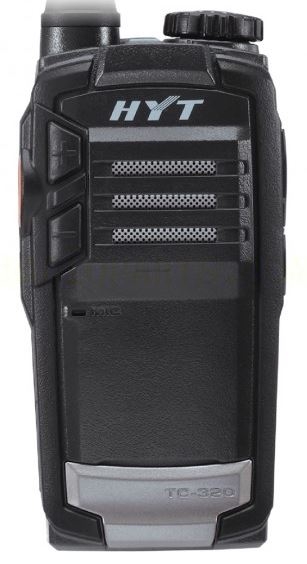
Hytera TC-320 U1

Specs: 2W, 16 channels, UHF (450–470MHz)
Pros:
  • Affordable entry-level option
  • Lightweight and compact for everyday use
  • 16 channels provide flexibility for small teams

Cons:
  • Lower 2-watt output limits range, best for short distances
  • Not as durable as higher-end models
  • Fewer professional-grade features

Best For: Small businesses, schools, or casual users needing short-range communication on a budget.
ICOM F200

Specs: 2W, 16 channels, UHF (450–470MHz)
Icom F200 11 Two-Way Radio - 2W, 16C, Includes Charger, UHF(450-470MHz) - IC02
15-Hrs Talk-Time
USB-C Charging
The compact body fits in the palm of your hand, featuring an elegant and smart design unlike anything before.
This sturdy handheld transceiver meets user-friendly operability with a new front panel layout design, hands-free VOX function, Voice Guide when switching channels, IP54 dust and water resistance meeting MIL-STD810G with a light-weight and rugged polycarbonate case
Pros:
  • Affordable entry-level option
  • Lightweight and compact for everyday use
  • 16 channels provide flexibility for small teams

Cons:
  • Lower 2-watt output limits range, best for short distances
  • Not as durable as higher-end models
  • Fewer professional-grade features

Best For: Small businesses, schools, or casual users needing short-range communication on a budget.

Motorola CLS1410

Specs: 2W, 16 channels, UHF (450–470MHz)
Pros:
  • Affordable entry-level option
  • Lightweight and compact for everyday use
  • 16 channels provide flexibility for small teams

Cons:
  • Lower 2-watt output limits range, best for short distances
  • Not as durable as higher-end models
  • Fewer professional-grade features

Best For: Small businesses, schools, or casual users needing short-range communication on a budget.

Hytera TC-320 U1 Two-Way Radio - 2W, 16C, UHF(450-470MHz) - H07S

Hytera TC-320 U1 Two-Way Radio - 2W, 16C, UHF(450-470MHz) - H07S

Icom F200 11 Two-Way Radio - 2W, 16C, Includes Charger, UHF(450-470MHz) - IC02

Icom F200 11 Two-Way Radio - 2W, 16C, Includes Charger, UHF(450-470MHz) - IC02

Motorola CLS1410 Two-Way Radio - 1W, 4C, UHF - M03

Motorola CLS1410 Two-Way Radio - 1W, 4C, UHF - M03

FAQs - Common Questions about Analog Two Way Radios

Q: What is an analog twoway radio?

An analog two-way radio (also called a walkie-talkie or handheld transceiver) transmits and receives voice using continuous radio frequency (RF) waves. Audio is encoded directly onto a carrier wave using frequency modulation (FM) or, less commonly, amplitude modulation (AM). Unlike digital radios, analog radios do not convert voice to binary data — they are simpler, lower-cost, and backward compatible with legacy systems.

Q: What is the range of an analog two way radio?

Range depends on terrain, obstructions, and transmit power. General estimates:
Handheld (0.5–5W): 0.5–3 miles in urban/wooded areas; up to 5–7 miles open terrain
Mobile/vehicle-mounted (25–100W): 5–25 miles line-of-sight
Base stations with external antennas: 10–50+ miles depending on antenna height
Repeater-linked systems: 50–100+ miles across a network

Q: What is the difference between analog and digital two-way radios?

Analog
Voice modulated directly onto carrier. Degrades gracefully — static increases as signal weakens but speech remains intelligible. Lower cost, simpler hardware.
Digital (DMR, P25, NXDN)
Voice converted to data packets. Cleaner audio and encryption available. When signal drops below threshold, audio cuts out entirely (the "digital cliff" effect). Higher cost.
Best rule of thumb: choose analog for simplicity and budget; choose digital for noise-heavy environments, over-the-air encryption, or data features.

Q: What frequencies do analog two-way radios use?

VHF (136–174 MHz)
Longer wavelengths. Better outdoor range and vegetation penetration. Ideal for farms, golf courses, ski resorts, maritime.
UHF (400–512 MHz)
Shorter wavelengths bounce through buildings and steel structures. Standard for hotels, hospitals, warehouses, urban job sites.
Consumer radios: FRS/GMRS operate in the 462–467 MHz UHF band. Business and public safety radios require licensing and may use VHF, UHF, 700 MHz, or 800 MHz bands.

Q: What is CTCSS and DCS?

CTCSS (Continuous Tone-Coded Squelch System) encodes a sub-audible tone (67–254.1 Hz) into transmissions. The receiving radio's squelch only opens when the matching tone is detected, blocking out other users on the same channel. DCS (Digital-Coded Squelch) uses a digital code instead of a tone. Neither provides encryption — anyone with a scanner can still hear your transmissions. They reduce unwanted chatter on shared channels and are standard on most business radio systems.

Q: Do I need a license to use an analog two-way radio?

It depends on the radio type and power output:
No license required — FRS (Family Radio Service): up to 2W on 22 shared channels
No license required — MURS (Multi-Use Radio Service): up to 2W on 5 VHF channels
License required — GMRS: FCC license required in the USA (covers immediate family)
License required — Business/commercial Part 90 radios on licensed frequencies
License required — Amateur (ham) radios: FCC Technician, General, or Extra class
Operating unlicensed on licensed frequencies is a federal violation subject to fines.

Q: How long do analog two-way radio batteries last?

Battery life depends on duty cycle (ratio of TX / RX / standby) and battery capacity. Typical performance on a 5/5/90 duty cycle (5% transmitting, 5% receiving, 90% standby):
Standard Li-ion (1800–2200 mAh): 8–12 hours
High-capacity Li-ion (2600–3400 mAh): 14–18 hours
NiMH / alkaline pack: 4–8 hours typical
Tip: transmitting at full power is the largest battery drain. Reducing TX power when range allows can meaningfully extend runtime.
Tip: don't let radio sit on charger all-day and all night

Q: What does IP rating mean on a two-way radio?

IP (Ingress Protection) rating indicates resistance to dust and water. Format: IP followed by two digits — e.g., IP67 means fully dust-tight (6) and can be submerged in up to 1 meter of water for 30 minutes (7).
IP54
Dust/splash resistant
Light outdoor, retail
IP55
Dust-tight + water jets
Construction, events
IP67
Dust-tight + 1m submersion (30 min)
Public safety, warehouses
IP68
Dust-tight + continuous submersion
Maritime, tactical
IP rating·waterproof·rugged·MIL-STD-810·durability

Q: What is a repeater and how does it work for Analog?

A repeater is a fixed station that simultaneously receives on one frequency (the input) and retransmits on another (the output) at higher power from an elevated location — hilltop, tower, or building rooftop. Handheld radios set with the matching offset (typically ±600 kHz on VHF, ±5 MHz on UHF) automatically transmit to the repeater's input and receive on its output. This can extend a 1-watt handheld's effective range from 1 mile to 50+ miles across the repeater's coverage footprint.
Two-Way Radio Channel Capacity and Spectrum Efficiency in Modern Analog Radios

FAQS - Frequently Asked Questions Analog Two Way Radios

Most Common Questions about Analog Two Way Radios

  • Compatibility & Configuration

  • Do “privacy codes” make my conversations private?

    CTCSS/DCS codes keep your squelch closed to other users, but they are not encryption. For true privacy choose a digital system with proper encryption features and manage keys carefully.
  • Can I mix brands in one fleet?

    Yes if you keep to the same standards. On analog, match frequencies and tones. On DMR, match color codes, time slots, and talkgroups. Features like encryption and text may be brand specific, so plan your feature set accordingly.
  • Can two-way radios communicate with other radios?

    Yes, if both radios share the same frequency, channel, and signaling codes. Otherwise, they are incompatible.
  • What accessories matter most on the floor?

    RSMs for loud zones, noise-reducing headsets where required, and multi-bank chargers staged by department. Consistent mic distance improves intelligibility more than model names do.
  • How many channels or talkgroups do we need?

    As few as possible to mirror real workflows: a site-wide, emergency, and 3–5 role channels/talkgroups cover most operations. Over-choice slows response.
  • How do we keep conversations private?

    CTCSS/DCS (“privacy codes”) only quiet the squelch. For real privacy, use digital with encryption and manage keys carefully. Keep sensitive details off SITE.
  • What is a repeater and how does it work with analog radios?

    A repeater is a fixed station that simultaneously receives on one frequency (the input) and retransmits on another (the output) at higher power and from an elevated location (hilltop, tower, building rooftop).
    Handheld radios set with the matching offset (typically ±600 kHz on VHF, ±5 MHz on UHF) will automatically transmit to the repeater's input and receive on the output. This can extend a 1-watt handheld's effective range from 1 mile to 50+ miles across a repeater's coverage area.
  • How long do analog two-way radio batteries last?

    Battery life depends on duty cycle (ratio of transmitting to receiving to standby) and battery capacity:
    Standard Li-ion battery (1800–2200 mAh): 8–12 hours on a 5/5/90 duty cycle (5% TX, 5% RX, 90% standby).
    High-capacity battery (2600–3400 mAh): 14–18 hours.
    Nimh/alkaline packs: 4–8 hours typical.
    Transmitting at full power is the biggest battery drain. Lowering TX power when range allows can extend life significantly.
  • What accessories matter most?

    RSMs for yard/security, earpieces for office/admin, and multi-unit chargers in key rooms. These improve intelligibility and readiness without changing radios.
  • How do I keep FOH conversations discreet?

    Use earpieces and, if needed, digital with encryption for sensitive traffic. Keep private details off the SITE channel.
  • How many channels should I plan?

    As few as possible to cover real workflows. Many shows succeed with SITE, OPS, SECURITY, MEDICAL, BOX, F&B, AV/TECH, EMERGENCY—then prune if something is unused.
  • Will “privacy codes” keep others from listening?

    No. CTCSS/DCS only control when your radio opens squelch. For real privacy, choose digital with encryption and manage keys.
  • How to program two-way radios for business?

    Use the manufacturer’s programming software or keypad entry to assign frequencies, channels, CTCSS/DCS tones, and features according to your business license and communication needs.
  • Are two-way radios encrypted?

    Analog radios usually are not. Digital radios may support encryption for secure communication, depending on the model and system.
  • How many channels should we have?

    As few as possible to cover real workflows often 6–7 total including SITE and EMERG. Keep names short and consistent across all radios.
  • Coverage & Performance

  • How much range/coverage do I need for my property size?

    A standard 18-hole golf course covers 100–200+ acres. For flat, open terrain, a quality UHF or VHF handheld radio can cover 1–2 miles. Wooded, hilly, or architecturally complex courses may see range drop significantly — sometimes to under half a mile.
    Rule of thumb: test radios on your specific property before committing to a system. Many vendors offer demo units for site walks.
  • General

  • How do I identify my radio's connector type?

    Check your radio's model number against the manufacturer's documentation, or refer to the connector guide on your radio supplier's website. Common connector families include Kenwood K1 (2.5mm + 3.5mm), Kenwood K2 (single 3.5mm), Motorola M6 (single pin), and various multi-pin proprietary connectors used by Motorola, Hytera, and ICOM professional-grade radios.
  • Do I need a license?

    Most professional business systems do. A license gives cleaner operation and supports repeaters and external antennas. Align your radio’s emission designators and bandwidth with the license.
  • What is the difference between a 1-wire and 2-wire earpiece?

    A 1-wire earpiece integrates the microphone, PTT, and speaker into a single cable. A 2-wire kit separates the PTT/mic assembly from the earpiece speaker, giving users more flexibility in where each component is positioned on the body.
  • What are the three use guidelines for two-way radio use?

    Keep transmissions short and clear, use standard radio etiquette (listen before talking, avoid interrupting), and identify yourself or your unit at the start of each message.
  • What frequency does the Kenwood NX-P1300AUK operate on

    Operates on UHF frequencies between 451–470 MHz using analog FM transmission. UHF frequencies in this band are part of the FCC-regulated business radio spectrum. UHF is ideal for indoor and urban environments because the shorter wavelengths penetrate walls and obstacles more effectively than VHF. The radio is pre-tuned to this range; specific channel frequencies within 451–470 MHz are assigned by your FCC license.
  • What is the difference between a walkie talkie and a two-way radio?

    A walkie-talkie is a type of two-way radio designed for short-range, portable communication, often handheld and used without external antennas or base stations. "Two-way radio" is a broader term that includes handheld units, mobile units in vehicles, and base stations with varying ranges and power levels.
  • What is the range?

    Kenwood rates the NX-P1300AUK  has indoor coverage of approximately 370,000–444,000 sq ft or up to 33–39 floors. Open-area outdoor range can be several miles under ideal conditions. Quoted square footage and floor counts are best-case estimates tested in large commercial buildings. Real-world range is affected by building materials, interference, terrain, and vegetation. The radio is repeater-capable, meaning you can extend range significantly by routing communication through a fixed repeater station.
  • What is PTT on a two-way radio?

    Push-To-Talk: the button that switches the radio from receive mode to transmit mode.
  • What is the power output?

    Has a maximum transmit power output of 5 watts.5 watts is the maximum output permitted for portable radios in the FCC Part 90 business band. Some retailers list this radio at 4W — the correct specification confirmed by Kenwood and the FCC ID filing is 5W.
  • How many channels do we need for a store our size?

    A typical box store needs at minimum 3–5 channels: one per department (floor, receiving, management/loss prevention, maintenance). Separate management and LP channels prevent routine chatter from flooding critical communications. Large-format stores (100,000+ sq ft) often use 6–10 channels plus a dedicated all-call.
  • What is a two-way radio?

    A two-way radio is a communication device that can both transmit and receive audio signals, allowing real-time, back-and-forth conversations between users. Sometimes referred at a walky talky.
  • How many channels does the NX-P1300AUK support?

    The NX-P1300AUK has 64 total channels organized across 4 zones with 16 channels per zone. The zone/channel structure lets large organizations segment communication by department, floor, building, or work group — for example: Zone A = Warehouse, Zone B = Security, Zone C = Management, Zone D = Logistics. Channels are fully programmable via PC using an optional programming cable and Kenwood software.
  • Are two-way radio earpieces universal?

    No. Two-way radio earpieces use different connector types that vary by radio manufacturer and model family. Always confirm that the earpiece connector matches your specific radio before purchasing. Most reputable earpiece products list compatible radio models and connector types in their product specifications.
  • Can the NX-P1300AUK be upgraded to digital?

    Yes. The NX-P1300AUK  it can be software-upgraded to NXDN or DMR digital operation by purchasing an optional license key — no new hardware required. This design lets you buy analog radios today and unlock digital capability as your budget or needs change. Digital mode offers clearer audio at the edge of coverage, improved battery life, and support for features like encryption and text messaging. Both NXDN (Kenwood's proprietary standard) and DMR (open industry standard) paths are available.
  • How long does the battery last?

    The included KNB-45L 2,000 mAh Li-ion battery delivers up to 11.5 hours of battery life under typical use conditions.Battery life is measured at a standard 5-5-90 duty cycle (5% transmit, 5% receive, 90% standby). Heavy transmit use will shorten runtime. The radio has a built-in battery saver with High, Medium, and Low settings to extend standby time. The KSC-35 rapid-rate charger is included and returns the battery to full charge faster than a standard charger.
  • Does the NX-P1300AUK require an FCC license

    Yes. it operates on licensed UHF business band frequencies and requires an FCC Part 90 license (FCC Form 601) before it is legally placed into service.Business band radios in the 451–470 MHz range are not license-free consumer devices. You must apply through the FCC Universal Licensing System (ULS) at fcc.gov. The license is granted to your business or organization, not to the individual radio. Before submitting Form 601, you must select the specific frequencies your operations will use; available frequencies are listed in the owner's manual. Licenses are typically valid for 10 years and are renewable.
  • What earpiece is best for noisy environments?

    For high-noise environments, a headset-style earpiece — either single or dual ear — provides the best noise isolation. Dual-ear headsets with active noise reduction offer the highest performance. If discretion is also required in a moderately noisy setting, a 2-wire acoustic tube earpiece is a strong compromise.
  • What does HD (High-Definition) mean for a two-way radio earpiece?

    HD earpieces use premium audio components — most commonly Knowles-brand speakers and microphones — to deliver noticeably clearer sound reproduction compared to standard earpieces. They also typically feature reinforced cable construction. HD earpieces are most valuable in environments where audio accuracy directly affects safety or operational performance.
  • Manufacturing and Warehouse Operations

    UHF is usually best indoors because it penetrates racking and walls more effectively. If your operation includes large outdoor yards or open land, test VHF for those areas—but expect to prefer UHF inside.
  • What are the disadvantages of two-way radios?

    Limited range, susceptibility to interference, need for FCC licensing on certain bands, and generally lower audio quality compared to modern digital communication tools.
  • Is the NX-P1300AUK waterproof or water-resistant?

    Is rated IP54/55 for dust and water resistance and meets MIL-STD-810 C/D/E/F/G environmental standards. It is splash- and rain-resistant, not submersible.IP54 means the radio is protected against dust ingress and water splashed from any direction. IP55 adds protection against low-pressure water jets. MIL-STD-810 testing covers shock, vibration, humidity, altitude, and temperature extremes. It is suitable for outdoor job sites, loading docks, and warehouses — but should not be submerged.
  • Can I use the same earpiece for different radios?

    Only if both radios use the same connector type. Many professional users purchase modular earpiece systems — such as the Voiceporter Snap-LOC series — where the earpiece itself snaps onto different base cords, each terminating in a different radio connector. This approach allows teams with mixed radio fleets to standardize on one earpiece type.
  • How do you communicate on a two-way radio?

    Select the correct channel, press PTT, identify yourself, deliver a clear message, and release PTT to listen for a reply.
  • Why do my radios lose signal in certain areas of the store?

    Large metal shelving, refrigeration units, concrete walls, and steel beams all block or reflect radio signals. Dead zones are most common near freezer sections, loading docks, and lower basement floors. Solutions include adding a signal repeater, switching to a higher-powered radio, or using a digital radio system with better signal penetration.
  • Do two-way radios have GPS?

    Some advanced digital radios (DMR, P25, TETRA) include built-in GPS for location tracking, but basic models typically do not.
  • Licensing & Regulations

  • Does a foot pedal PTT work with any radio brand?

    Q3 - Does a foot pedal PTT work with any radio brand? Foot pedal PTT switches are not universally compatible. Compatibility depends on the radio's accessory connector type. Most professional-grade radios from Kenwood, Motorola, Hytera, and ICOM support external PTT accessories through a standard 2-pin or multi-pin accessory port. Always confirm connector compatibility before purchasing.
  • Will the battery last a full shift?

    The PNC360S comes with a 4,000 mAh battery that provides power for an entire shift easily on a single charge. Fast charging gives hours of power in minutes of charge
  • Do we need to install any infrastructure at the hotel or airport?

    No infrastructure is required. The PoC solution requires no infrastructure, it operates over existing 4G/5G/LTE networks with nationwide coverage.
  • Do these radios work at the airport and inside the hotel building?

    Yes. The PNC360S enables communications using existing 4G/5G/LTE networks and Wi-Fi. Hytera (https://www.hytera.us/products/pnc360s-ptt-lte-iot-radio/) Inside the hotel, the radio uses Wi-Fi; outside and at the airport, it switches seamlessly to LTE so coverage is continuous.
  • What is the difference between analog and digital two-way radios?

    Analog radios modulate voice directly onto a carrier wave. They degrade gracefully — as signal weakens you hear static, but speech is still intelligible.
    Digital radios (DMR, P25, NXDN) convert voice to data packets. They offer cleaner audio, encryption, and added features, but when signal drops below a threshold, audio cuts out entirely (the "digital cliff effect"). Digital radios also tend to cost more.
    Best rule of thumb: analog for simplicity and budget; digital for noise-heavy environments, security, or data features.
  • What frequencies do analog two-way radios use?

    The two main frequency bands are:
    VHF (Very High Frequency) — 136–174 MHz: Better range outdoors and in open terrain; signals penetrate foliage well.
    UHF (Ultra High Frequency) — 400–512 MHz: Better penetration through buildings and in urban environments.
    GMRS and FRS consumer radios operate in the 462–467 MHz UHF band. Business and public safety radios are licensed and can use VHF, UHF, 700 MHz, or 800 MHz bands.
  • What is an analog two-way radio?

    An analog two-way radio (also called a walkie-talkie or handheld transceiver) transmits and receives voice communications using continuous radio frequency (RF) waves. The audio signal is encoded directly onto a carrier wave using frequency modulation (FM) or, less commonly, amplitude modulation (AM).
    Unlike digital radios, analog radios do not convert voice to binary data. They are simpler, lower-cost, and work well in environments where legacy compatibility matters.
  • Will a Bluetooth headset work reliably inside a crane cab?

    Generally yes, but metal cab construction can reduce Bluetooth range. Most crane cab Bluetooth applications operate well within the 10–30 foot range between headset and radio adapter. For tower crane operators who may move throughout the cab, a tested Bluetooth connection should be established before each shift to confirm reliable pairing. For high-interference environments, a wired headset with a remote PTT is the more dependable choice.
  • Can the hotel front desk talk to one driver privately, or only broadcast to all?

    Both. These radios support individual (one-to-one) calls and group calls (broadcast to all), so a front desk agent can privately contact a specific shuttle driver or announce to the entire fleet simultaneously.
  • Do I need a license to use an analog two-way radio?

    It depends on the radio type and power:
    No license required: FRS (Family Radio Service) radios operate at ≤2W on shared channels. MURS (Multi-Use Radio Service) allows up to 2W on 5 VHF channels.
    License required: GMRS requires an FCC license (USA). Business/commercial radios on licensed frequencies require a Part 90 license. Amateur (ham) radios require an FCC Technician, General, or Amateur Extra license.
    Operating unlicensed on licensed frequencies is a federal violation.
  • Can hotel front desk staff track where the shuttle is in real time?

    Yes. GPS enables real-time tracking and positioning for the Hytera HALO Dispatch application. A dispatcher at the front desk can view shuttle locations on a web browser-based map.
  • FCC Two-Way Radio License FAQ for Businesses | Two Way Radio Reference

    FCC Two-Way Radio License FAQ for Businesses | Two Way Radio Reference

    Answers to the top FCC two-way radio license questions for businesses. Learn costs, how to apply, what requires a license, GMRS vs Part 90, and more.

    FCC two-way radio license, business radio license, Part 90 license, GMRS license, do I need FCC license for walkie talkie, FCC radio license cost

    FCC Two-Way Radio License FAQ for Businesses

    Top FCC licensing questions answered for business owners. Costs, timelines, GMRS vs Part 90, penalties, and more.

    THE BASICS: DO YOU NEED A LICENSE?
    Q01. Do I need an FCC license to use two-way radios for my business?
    Answer - Most likely yes. Almost all UHF (400–512 MHz) and VHF (136–174 MHz) professional business radios require an FCC Part 90 Industrial/Business Pool license to operate legally in the United States.
    The exceptions are license-free radio services: FRS (Family Radio Service, 2W max, fixed antenna), MURS (Multi-Use Radio Service, 5 VHF channels, 2W max), CB (Citizens Band, 40 channels, 4W), and 900 MHz ISM band radios like the Motorola DTR series. These are genuinely license-free but offer limited coverage, no dedicated frequencies, and no interference protection.
    Industry estimates suggest that 80–90% of businesses using professional radios do not have an FCC license — which means they are operating illegally and are exposed to significant fines.
    Tags: Part 90, FRS, MURS, UHF/VHF
    Source note: 47 CFR Part 90 · FCC Industrial/Business Pool Rules

    Q02. What radios do NOT require an FCC license?
    Answer - The following radio services do not require a user license to operate:
    FRS (Family Radio Service) — 2W max, fixed antenna, no repeaters. Best for: consumer use, events, small teams.
    MURS (Multi-Use Radio Service) — 2W max, 5 VHF channels, no repeaters. Best for: retail, warehouses, small sites.
    CB (Citizens Band) — 4W AM, 40 channels, no repeaters. Best for: trucking, short-range.
    900 MHz ISM Band — power varies, no repeaters. Best for: digital business use (e.g., Motorola DTR series).
    Note: GMRS (General Mobile Radio Service) does require a license ($35, Part 95E), though it is sometimes mistaken for license-free. None of these services provide dedicated frequency assignments or FCC interference protection.
    FRS, MURS, CB, License-Free
    Q03. What is the difference between Part 90 and GMRS for businesses?
    Answer - Part 90 (Industrial/Business Pool) is the correct license for professional commercial operations. It allows higher power, repeaters, external antennas, and site-specific frequency assignments with interference protection.
    GMRS (General Mobile Radio Service, Part 95E) is a personal radio service designed for family and short-range use. It is not designed for high-powered commercial operations and does not provide the same level of spectrum protection.
    Comparison:
    Part 90 vs. GMRS:
    - Purpose: Commercial operations vs. Personal/family use
    - Max Power: Up to 100W (site dependent) vs. 50W (mobile)
    - License Cost: $300–$800+ vs. $35
    - Repeaters: Yes, licensed vs. Yes, shared
    - Dedicated Frequencies: Yes, site-specific vs. No, shared pool
    - Interference Protection: Yes, FCC enforced vs. Limited
    - Reselling Airtime: Allowed (with SMR) vs. Not allowed
    - License Term: 10 years vs. 10 years
    The bottom line: GMRS is a low-cost option for simple coordination needs, but it is not designed for commercial operations where frequency exclusivity and system reliability are mission-critical. Businesses that depend on radio communication should use Part 90.
    GMRS, Part 90, Part 95

    Q04. What is the difference between UHF and VHF — and which needs a license?
    Answer - Both UHF and VHF business radio bands require a Part 90 license for professional operation. Here is how to choose:
    UHF (Ultra High Frequency, 400–512 MHz): Better for indoor environments. Shorter wavelengths penetrate concrete, steel, and building materials more effectively. Best for: hotels, hospitals, warehouses, construction sites, and urban campuses.
    VHF (Very High Frequency, 136–174 MHz): Better for wide open outdoor coverage. Longer wavelengths travel farther over flat terrain. Best for: farms, golf courses, marinas, open construction sites, and parks.
    If unsure, your frequency coordinator will evaluate your site and recommend the right band. Many businesses program both bands into their fleet.
    UHF, VHF, Band Selection

    CATEGORY 02 — COSTS & FEES
    Q05. How much does an FCC business radio license cost?
    Answer - There is no single flat fee — costs vary by service type and how much help you use. Here is a realistic breakdown:
    FCC filing fee (Part 90): approximately $65 per application
    Frequency coordinator fee: $100–$400+
    Professional filing assistance: $200–$500 (optional)
    Total Part 90 license: approximately $300–$800+
    GMRS individual license: $35 (no coordinator needed)
    The license covers unlimited radios on your licensed frequencies — you are not charged per device. Spread over a 10-year license term, this is a very low annual cost relative to the protection it provides.
    Tags: Cost, FCC Fees, Coordinator Fees
    Source note: 47 CFR § 1.1102 · FCC CORES fee schedule

    Q06. How long is an FCC license valid?
    Answer - Part 90 Industrial/Business licenses are valid for 10 years. GMRS licenses are also valid for 10 years. The license is not issued per device — it covers all radios operating under your licensed frequencies during that 10-year period.
    The FCC sends renewal reminder notices to the contact email on file in your CORES account. You can file for renewal up to 90 days before expiration. If your license lapses without renewal, you must reapply as a new application — which restarts the full coordination process.
    License Term, Renewal

    Q07. What are the penalties for operating without an FCC license?
    Answer - ⚠ CALLOUT — FCC Enforcement:
    FCC fines for unlicensed radio operation start at $10,000 per violation and can reach $25,000–$100,000 for willful or repeat violations. Hotel and hospitality operators have received fines in the $25,000–$50,000 range for commercial unlicensed use.
    Beyond monetary fines, the FCC can order equipment confiscation and operational shutdowns. Unlicensed operators also have no legal right to report interference — if another business is disrupting your communications, you have no recourse without a license.
    The cost of a license ($300–$800 over 10 years) is always less than a single FCC fine. Compliance is the practical choice, not just the legal one.
    Tags: Fines, Enforcement, Compliance
    Source note: 47 U.S.C. § 503(b) · FCC Enforcement Bureau
    CATEGORY 03 — HOW TO APPLY
    Q08. How do I apply for an FCC Part 90 business radio license?
    Answer - The standard Part 90 licensing process follows these steps:
    Step 1 — Define requirements. Determine your coverage area, band (UHF or VHF), whether you need a repeater, and if encryption is required for sensitive traffic.
    Step 2 — Engage a frequency coordinator. Provide your site address, antenna height, building description, and use case. The coordinator recommends channels and power levels that will not conflict with nearby licensees.
    Step 3 — Create an FCC Registration Number (FRN). Register at apps.fcc.gov/cores under your correct legal business entity name and address.
    Step 4 — File FCC Form 601 through the Universal Licensing System (ULS) at wireless.fcc.gov, using the coordinator's frequency data.
    Step 5 — Pay the filing fee (~$65) when prompted. The application is not accepted until payment clears.
    Step 6 — Receive call sign and license grant. Most uncontested applications are processed within 1–2 weeks after coordination is complete. Store the grant document in your compliance binder.
    Tags: Form 601, ULS, CORES, Application Process

    Q09. What is a frequency coordinator and do I need one?
    Answer - A frequency coordinator is an FCC-certified private organization that recommends the most appropriate frequencies for your location before you file your application. For Part 90 new licenses and most major modifications, frequency coordination is required — not optional.
    Coordinators search the FCC database for nearby licensees, run distance-separation and contour studies, and recommend channels and power levels that will achieve your coverage without causing harmful interference to others. Some perform on-site spectrum scans to detect unlisted interferers.
    Well-known coordinators include the Enterprise Wireless Alliance (EWA), APCO International, and various regional organizations. Your radio dealer or vendor can often recommend one appropriate for your band and geography.
    Tags: Frequency Coordination, EWA, APCO
    Source note: 47 CFR § 90.175 — Frequency coordination requirements

    Q10. Can I start operating before my license is granted?
    Answer - Yes — under Conditional Authority (47 CFR § 90.159). You may begin operating 10 business days after submitting a fully coordinated application and may continue for up to 180 days while your application is pending, provided that:
    - Your site is outside Canadian or Mexican border coordination zones.
    - You are not requesting any rule waivers.
    - Your antenna complies with FAA notification and environmental rules.
    If the FCC dismisses or denies your application, conditional authority ends immediately. For truly urgent deployments — emergencies, short-duration events — a Special Temporary Authority (STA) can be filed using Form 601 for up to 180 days with a written justification.
    Tags: Conditional Authority, STA, § 90.159

    Q11. What are itinerant frequencies and can my business use them?
    Answer - Itinerant frequencies are pre-designated channels in the Industrial/Business Pool that businesses can use when operating away from their primary licensed site — at a temporary job site, event, or new location not yet on their license.
    Itinerant operations do not require site-specific coordination or a modification to your existing license. However, they carry no interference protection — anyone else using the same itinerant channel has equal right to it. They are best used as a supplement to on-site licensed channels, not a replacement.
    Many businesses program itinerant channels alongside their licensed site channels in their radio fleet, with clear labeling so users know which channel to use and when.
    Tags: Itinerant, Temporary Sites, Mobile Operations

    Q12. Do repeaters need their own FCC license?
    Answer - Yes. A repeater is a fixed base station and must be explicitly licensed. When you apply for your Part 90 license, you specify the repeater's location coordinates, antenna height, effective radiated power (ERP), and operating frequencies as part of the application.
    If you add a repeater after your initial license is granted, you must file a major modification and complete new frequency coordination before the repeater goes live. Operating an unlicensed repeater carries the same penalty exposure as any other unlicensed operation.
    Tags: Repeater, Base Station, Infrastructure

    CATEGORY 04 — OPERATIONS & COMPLIANCE

    Q13. Does an FCC license cover all my radios, or is it per device?
    Answer - An FCC Part 90 license covers your licensed frequencies, not individual devices. You can operate any number of radios programmed to your licensed channels under a single license. There is no per-radio fee, per-device registration, or limit on fleet size.
    This makes Part 90 licensing extremely cost-effective for larger deployments. A single license can cover a fleet of 5 radios or 500 radios equally — the license cost does not scale with device count.
    Fleet Size, Per-Device, License Scope
    Q14. What is a Special Temporary Authority (STA) and when do I need one?
    Answer - A Special Temporary Authority (STA) is an FCC authorization for urgent radio operations that cannot wait for a standard license or modification. STAs are valid for up to 180 days.
    Common STA scenarios include: temporary construction projects at an unlicensed site, short-term events (festivals, conventions), emergency response deployments, and testing new equipment before a permanent license is issued.
    STAs are filed electronically using FCC Form 601 and must include a detailed narrative explaining the circumstances that justify the STA. The FCC typically processes STA requests within a few business days for emergency situations.
    Tags: STA, Temporary Authority, Events
    Source note: 47 CFR § 90.151 — Special Temporary Authority

    CATEGORY 05 — RENEWALS & CHANGES

    Q15. What happens to my FCC license if my business changes name, ownership, or location?
    Answer - Any material change to your business or radio system requires action on your license:
    Business name or ownership change: Update your FCC CORES account and file an administrative update on the license to reflect the new legal entity. Licenses are not automatically transferred in business sales — this must be done deliberately to ensure renewal notices continue to reach the right party.
    New location: File a major modification and work with your frequency coordinator to re-evaluate channels and antenna parameters for the new site. You cannot operate at the new location under your old site license until the modification is granted (or conditional authority applies).
    Adding a repeater or new coverage area: Requires a major modification and new frequency coordination before the system changes go live.
    Minor administrative updates (updating contact info, correcting typos) can be filed directly through the ULS without coordinator involvement.
    Tags: Modification, Renewal, Ownership Transfer, ULS
    RENEWAL REMINDER CALLOUT:
    Set two calendar reminders: one 6 months before expiration and one 90 days before. Confirm your CORES email address is current. Log into ULS at wireless.fcc.gov to verify your expiration date and file your renewal early.


    GLOSSARY / KEY TERMS SECTION

    Part 90:
    The FCC rules (47 CFR Part 90) governing Private Land Mobile Radio Services. Covers the Industrial/Business Pool, Public Safety Pool, and other land mobile services requiring licensed frequencies.
    PLMR (Private Land Mobile Radio):
    The umbrella term for non-broadcast, two-way radio systems used by businesses, public safety agencies, and government entities under FCC Part 90.
    FRN (FCC Registration Number):
    A unique identifier issued by the FCC to each licensee through the CORES registration system at apps.fcc.gov/cores. Required before any license application can be filed.
    Emission Designator:
    A standardized code that describes the type of radio transmission — modulation type, signal type, and information type. For example, 11K0F3E indicates narrowband FM analog voice. Specified on FCC Form 601.
    ERP (Effective Radiated Power):
    The actual power radiated from an antenna, combining transmitter output power and antenna gain. The ERP defines your interference footprint and is a required field in FCC license applications.
    HAAT (Height Above Average Terrain):
    The height of an antenna above the average terrain elevation in a 2–10 mile radius around the transmitter site. A key parameter in calculating coverage and interference potential.
    ULS (Universal Licensing System):
    The FCC's online database and filing system at wireless.fcc.gov used to apply for, modify, renew, and look up radio station licenses.
    Itinerant Channel:
    Pre-designated Part 90 frequencies that licensed businesses can use away from their primary site without a site-specific modification.
  • The front desk staff aren't very tech-savvy. Are these radios easy to use?

    Yes. The PNC360S features an enhanced ergonomic design with a one-sided key layout, making the radio easier to use with one hand. The anti-slip texture surface reduces accidental drops even in moist conditions.
  • Which model is best for hotel-to-shuttle communication?

    It depends on the role:
    • MNC360 – Best for shuttle drivers; it mounts in the vehicle on the dashboard with a remote microphone, is DOT-compliant for safe use while driving, and has an automatic key-lock during driving.
    • PNC380S – Best for hotel staff who need a full-featured handheld with a display, GPS, and Bluetooth. Can also be vehicle-mounted with the optional CK10 Car Kit.
    • PNC360S – Best for hotel front desk staff, bellhops, concierge, and valet. Ultra-compact, fits in a pocket or on a lanyard, very affordable, and easy to use.
  • Can the PNC380S also be used in the shuttle van?

    Yes. The CK10 Car Kit is a rugged bracket assembly that enables the PNC380S to be installed on a vehicle dashboard. It provides safe and legal mobile operation and can be easily removed for handheld job-site communications. The Car Kit also functions as a docking charger for the PNC380S.
  • What is the difference between PTT and full-duplex communication for crane operators?

    Push-to-talk (PTT) systems — whether via foot pedal, remote switch, or button — require one person to transmit at a time. Full-duplex systems allow both the operator and signal person to speak and hear simultaneously, similar to a phone call. Full-duplex is faster and reduces the risk of missed commands in time-critical lifts, but typically requires a dedicated intercom system rather than a standard two-way radio setup.
  • What is a PoC radio and how is it different from a traditional walkie-talkie?

    PoC (Push-to-Talk over Cellular) radios work over 4G/LTE and Wi-Fi networks rather than licensed radio frequencies. This means your hotel front desk and shuttle drivers can communicate across any distance across town, across the city, even across state lines without dead zones or range limits.
  • Will the driver be able to hear the radio with the windows down or in a noisy van?

    Yes. The built-in 4-watt speaker comes with distortion suppression, howling suppression, and noise cancellation technology, which enables the MNC360 to transmit loud and clear audio even with the window rolled down in construction sites or bustling streets.
  • What is the range of an analog two-way radio?

    Range depends on terrain, obstructions, and radio power. Typical ranges:
    Handheld (0.5–5W): 0.5–3 miles in urban/wooded areas; up to 5–7 miles in open terrain.
    Mobile/vehicle-mounted (25–100W): 5–25 miles line-of-sight.
  • What subscription platform do these radios run on?

    The PNC360S is supported on the HORIZON and Hytera HALO Nationwide PoC subscription platforms, and on the HORIZON Dispatch and Hytera HALO Dispatch web-based group communications and fleet tracking applications.
  • What if a radio gets wet or is dropped?

    Certified with IP67 rating and MIL-STD-810H standard, the PNC360S is made tough to withstand water, dust, shock, extreme temperatures, and sudden drops up to 1.2 meters. Hytera PNC380S is IP55-rated.
  • Does OSHA require crane operators to use hands-free radios?

    Yes. Under OSHA 29 CFR 1926.1420, when radio or electronic signals are used to communicate with a crane operator, the operator's reception must be through a hands-free system. Holding a handheld radio while operating the crane is not compliant. A foot pedal PTT , remote-mounted PTT switch, or full-duplex headset system are the accepted compliant approaches.
  • Can one radio be used on multiple channels for both the signal person and site supervisor?

    Most professional digital two-way radios support scanning  across multiple channels or can be programmed with multiple channel groups. In practice, it is safer to dedicate one channel exclusively to the operator-signal person communication loop during active lifts, and use a second channel or a separate device for site supervisor coordination. Mixing lift commands with general site traffic on the same channel creates dangerous ambiguity.
  • Will the shuttle driver lose connection on the way to or from the airport?

    No. The exterior antenna design improves RX sensitivity by 2 dB, enabling smoother communication in areas with weak signal such as suburbs, indoors, or underground. Coverage follows the carrier network (AT&T or T-Mobile), which covers most metropolitan routes.
  • How long do Bluetooth crane headset batteries last on a full shift?

    Battery life varies significantly by model. Entry-level Bluetooth headsets may deliver 8–10 hours, while purpose-built industrial models such as the 3M Peltor LiteCom Pro III and Sensear SM1 series offer up to 20–24 hours of continuous use. For operations running double shifts or extended hours, select a model with a quick-swap battery option or charging dock that allows mid-shift recharging.
  • What NRR rating should a crane operator headset have?

    Noise Reduction Rating (NRR) indicates how many decibels of noise protection a headset provides. Crane cab noise levels typically range from 85–100 dB depending on equipment type. An NRR of 24–28 dB is recommended for most crane environments to bring exposure below the OSHA action level of 85 dB. Many purpose-built crane headsets, such as the 3M Peltor series, achieve NRR ratings in this range while integrating two-way radio communication.
  • Is it safe and legal for a driver to use the MNC360 while driving?

    Yes. The MNC360 is DOT-compliant for safe communication while driving. Keys on the MNC360 are automatically locked during driving, helping the driver focus more on the road and less on the radio. Drivers use the remote handheld microphone mounted within reach.
  • Power, Battery & Durability

  • What IP rating should I choose?

    For harsh or outdoor work, pick IP67. For typical indoor use with occasional wipe-downs, IP54/55 can suffice. If in doubt, go higher.
  • How long should batteries last?

    Plan for a full shift plus buffer (10–14 hours typical). Replace packs on an 18–30 month cycle and keep labeled spares at key locations.
  • How often should I replace radio batteries?

    Most fleets replace lithium-ion packs every 18 to 30 months depending on duty cycle and charging practices. Track purchase dates and retire packs that show shortened runtimes or cause distorted audio on transmit.
  • Do we need Intrinsically Safe (IS) radios?

    Only if your scope includes flammable atmospheres or the owner/GC requires IS. When required, use IS-certified radios and IS accessories—no exceptions.
  • Troubleshooting

  • Will more power fix our dead aisles?

    Usually not. Antenna height and placement beat watts. Extra power expands your interference footprint and drains batteries faster.
  • Why do my radios pick up other people’s conversations?

    You are likely on a shared or itinerant frequency or your CTCSS/DCS is disabled or mismatched. Program a unique tone or code for your fleet, or move to coordinated business frequencies. Digital systems with talkgroups also reduce unwanted traffic.
  • How far should my business radios work?

    Range depends on band, terrain, and infrastructure. Indoors with UHF portables you can expect coverage across most single buildings. Multi-building campuses often need a repeater or DAS. Outdoors in flat, open areas VHF can reach several miles line of sight. Height and antenna quality often matter more than raw power.
  • My audio is choppy. Is that a weak signal or a setting?

    Analog sounds noisy when weak. Digital often sounds robotic or drops syllables at the edge of coverage. First test with a fresh battery in a line-of-sight location. If choppiness remains in DMR, verify color code, time slot, and talkgroup. If you are scanning , confirm that scan list behavior is not causing missed words.
  • Other

  • What are radio waves?

    Electromagnetic waves in the frequency range of 3 kHz to 300 GHz, used for wireless communication, including two-way radios.
  • Should we choose analog or digital (DMR)?

    If you have light traffic and want simplicity, analog works well. If departments frequently overlap or calls get stepped on, DMR’s two time slots and talkgroups provide immediate relief and cleaner audio at the fringes.
  • Do I need a repeater for my event?

    If your venue is multi-story, sprawling, or has deep back-of-house areas, a single rooftop or mast-mounted repeater often makes coverage reliable. Small single-hall shows can run direct (simplex) without one.
  • What’s the quickest fix for “bad audio”?

    Swap to a known-good battery, tighten the antenna, remove the accessory to test the internal mic/speaker, and coach press-pause-speak with the mic 1–2 inches from the mouth.
  • Can vendors and subs use our system?

    Yes—give each subcontractor its own talkgroup/channel and control scan lists. Publish a simple radio etiquette sheet at onboarding.
  • Is GMRS better than CB?

    GMRS generally offers clearer audio, more privacy options, and longer range in some conditions. CB radios work without a license and are still popular among truckers, but GMRS can outperform CB for local communications.
  • Do I need digital (DMR) if my team is small?

    Not always. If calls rarely overlap and you value simplicity, analog works well. If traffic grows—or you hear stepped-on calls—DMR doubles talk capacity on the same license and usually cleans up fringe audio.
  • Do I need an FCC license for 2 way radio?

    It depends on the radio service. GMRS and amateur (ham) radios require an FCC license, while FRS and CB radios do not.
  • Can CB talk to GMRS?

    No, CB and GMRS use different frequencies and are not compatible with each other.
  • What about interference from wireless mics?

    Physically separate radio antennas from mic/IEM racks. Coordinate with AV on rigging locations and route radio coax away from power distro.
  • Will more power fix my dead zones?

    Usually not. Antenna height and placement beat raw watts. Extra power increases your interference footprint and can backfire in RF-dense venues.
  • Who is exempt from the GMRS fee?

    The FCC does not currently offer exemptions from the GMRS license fee for individuals.
  • Should we choose analog or digital (DMR)?

    Analog is simple and effective for small fleets. DMR adds capacity (two time slots), cleaner fringe audio, talkgroups, and options like unit IDs and encryption valuable for busy campuses.
  • Which signal is stronger, VHF or UHF?

    Neither is “stronger,” but VHF travels farther in open areas, while UHF penetrates buildings and obstacles better.
  • Can you get a GMRS license online?

    Yes, you can apply and pay for a GMRS license entirely online through the FCC’s Universal Licensing System.
  • What are the parts of a two-way radio?

    Antenna, speaker, microphone, PTT button, display/control panel (if present), battery, and internal transceiver circuitry.
  • Which radio does not require a license?

    FRS radios and CB radios can be used without an FCC license in the United States.
  • Can vendors and staff share the same system?d

    Yes—give vendors their own talkgroup/channel and limit what they can scan. Keep SITE for time-critical ops and EMERGENCY for command.
  • What is the best frequency for a two-way radio?

    Depends on environment: VHF for open/rural areas; UHF for indoor/urban settings.
  • How hard is it to get an FCC license?

    For GMRS, it’s straightforward: you apply online through the FCC’s system, pay the fee, and receive your license. There’s no test required.
  • Will a higher-power handheld fix coverage problems?

    Sometimes, but not always. Doubling power provides a relatively small improvement compared to raising the antenna, adding a repeater, or placing the user in a better RF location. Start with antennas and infrastructure.
  • What are the four types of antennas?

    Common categories: whip (omnidirectional), dipole, Yagi (directional), and parabolic (high-gain, focused).
  • Can friends use your GMRS license?

    Yes, your GMRS license covers your immediate family members, but not friends. Friends would need their own license to transmit legally.
  • Do police use GMRS?

    No, police use dedicated public safety radio systems on separate frequencies, not GMRS.
  • How far do CB radios reach?

    Typical CB range is 3–6 miles, though base stations and ideal conditions can extend range to about 15 miles.
  • Is GMRS better than ham?

    GMRS is easier to use and requires no exam, but ham radio offers much greater range, more frequency options, and worldwide communication potential.
  • How do we prevent stepped-on calls?

    Keep SITE for urgent, site-wide messages. Move coordination to role channels/talkgroups. Enable Busy-Channel Lockout and use short transmissions.
  • How far will GMRS go?

    Handheld GMRS radios can reach 1–5 miles, mobile units 5–20 miles, and repeater-assisted GMRS systems can exceed 50 miles.
  • What’s the quickest mid-shift fix for “bad range”?

    Swap to a known-good battery, check antenna tightness, remove accessories to test, and step toward line of sight. If multiple users report the same zone, move the antenna or add a temporary indoor antenna.
  • Do we need an FCC license?

    Professional business channels typically require licensing. Your vendor can coordinate licensed event-appropriate channels or provide access via a managed system.
  • What IP rating should we look for?

    IP67 is the sweet spot for harsh jobs: dust-tight and water-resistant. If conditions are milder, IP54/55 may suffice, but higher is safer on construction.
  • Why is audio muffled sometimes?

    Covered microphones, clogged mic ports, or speaking too close/far cause intelligibility problems. RSMs and consistent PTT technique fix most complaints.
  • Do we need an FCC license for school radios?

    Most professional systems do. Licensed business/industrial channels provide cleaner operation and allow external antennas and repeaters. License-free options exist for very small campuses, but power and privacy limits make them less reliable.
  • Will more power fix dead zones?

    Often no. Antenna height/placement beats watts, especially indoors. Extra power increases interference and drains batteries.
  • Should I choose VHF or UHF for a warehouse?

    UHF performs better through walls, steel, and racking. Choose UHF unless you have a specific line-of-sight outdoor requirement that favors VHF.
  • UHF or VHF—how do I decide?

    UHF usually wins indoors and on campuses; VHF can shine in wide-open outdoor sites. Borrow both and walk-test—a one-hour loop beats speculation.
  • Which band is best for construction?

    UHF is usually best inside structures and urban jobs. VHF can excel on long, open, horizontal sites. Test both if you’re unsure.
  • Analog or digital for a busy site?

    If you have more than two active, concurrent conversations or frequent stepped-on calls, DMR (two time slots on one repeater channel) pays off quickly.
  • Do truckers use GMRS or CB radios?

    Most truckers still use CB radios for road communication, but some are exploring GMRS for better clarity and range.
  • Do we need a repeater?

    If your building is large, multi-story, or has significant metal, a single rooftop or penthouse repeater often transforms reliability. Small, single-bay operations sometimes run direct (simplex) without one.
  • How much does it cost to get an FCC license for a radio station?

    For GMRS, the FCC license fee is $35 for 10 years. Broadcast radio station licenses can cost much more and vary depending on the service and application.
  • Analog or digital for a one-day festival?

    If you’ve got multiple active departments or a history of stepped-on calls, DMR is worth it. Two time slots on one channel reduce congestion and improve clarity.
  • What is the longest distance for a two-way radio?

    The maximum range depends on the radio type, power, antenna, and environment. Consumer-grade radios may reach 1–2 miles in urban areas, while high-power or base station radios can exceed 20–30 miles, and some systems using repeaters can reach hundreds of miles.
  • Are truckers switching to GMRS?

    Some are beginning to experiment with GMRS due to improved range and audio quality, but CB remains the dominant choice in trucking.
  • What’s the fastest fix mid-show for “bad audio”?

    Swap to a known-good battery, remove the accessory, and speak 1–2 inches from the mic after a one-second PTT pause. Check the antenna is tight and vertical.
  • Do we need a repeater or will handhelds be enough?

    If your project is multi-story steel/concrete or spans multiple buildings/laydown areas, a single high, central repeater often makes the difference between guesswork and reliable comms. Smaller, single-structure jobs can sometimes run direct (simplex).