


Best Two-Way Radios for Construction Sites: Durable Field Guide
By Bruce Fogelberg - www.twowayradio.com. We are commercial radio experts since 2000. , Two Way Radio Expert
Published: March 19, 2025
Last updated: March 30, 2026
On this page
- Purpose - Best Two-Way Radios for Construction Sites (Field Guide)
- Understand MIL-STD-810
- Understand UHF vs VHF for Construction Sites
- Understand FCC Licensing for Construction
- FCC source:
- 10 Step Two Way Radio Deployment Guide
- What is Rugged Mean for Construction?
- Best Equipment Picks for Construction
- Partnership Advantage
Purpose - Best Two-Way Radios for Construction Sites (Field Guide)
The goal of this article is provide an easy guide to selecting the proper equipment for your specific construction site use case.
Two-way radios are the backbone of communication on construction sites — but the wrong radio, poor coverage, or an inconsistent channel plan can turn a routine crane move into a safety incident. This guide walks through how to choose durable, IP-rated two-way radios built for harsh job site conditions, how to engineer reliable coverage across your site, and how to design and train crews on a channel plan simple enough that every safety call gets heard the first time.
Quick Answer

We will expand on most common searched questions for Construction
two-way radios for construction sites
construction site radios
best walkie talkies for construction
UHF vs VHF construction radio
DMR radio for construction crew
how to set up repeater on construction site
intrinsically safe radios construction
best IP67 radio for job site
two way radio channel plan construction
Understand MIL-STD-810
Why Construction Environments Demand Rigorous Testing
A commercial office laptop might experience a single accidental drop in its lifetime. A rugged tablet on a construction site might endure dozens of drops, constant vibration from compactors and jackhammers, exposure to concrete dust and sawdust, and temperature swings from a freezing pre-dawn start to a scorching afternoon — all within a single week. The following MIL-STD-810 test methods are particularly relevant to these conditions:
Key Test Methods for Construction Applications
Method 516 — Shock: Simulates the sudden impacts and drops that occur when devices are handled by workers wearing gloves, carried on uneven terrain, or knocked from elevated work surfaces. A device that passes shock testing across multiple drop orientations has demonstrated it can survive the physical reality of daily site use.
Method 514 — Vibration: Models the continuous, low-frequency vibration transmitted through heavy construction equipment. Devices mounted to vehicles, worn on tool belts, or placed near compaction equipment experience this kind of sustained mechanical stress. Failure modes include solder joint fatigue, connector loosening, and display delamination — none of which are immediately visible until the device stops working.
Method 510 — Sand and Dust: Construction sites generate fine particulate matter that infiltrates every unsealed gap in a device enclosure. Blowing dust tests assess whether a device can operate — and survive — in environments where particulate ingress is continuous. This test is distinct from IP-rated dust resistance and often applies more aggressive particle sizes and velocities.
Method 506 — Rain: Tests whether a device can withstand direct water exposure from heavy rain or washdown operations. On sites where concrete pouring, waterproofing, and pressure washing are routine, rain resistance is not optional.
Method 501 & 502 — High and Low Temperature: Construction equipment must function in the sweltering heat of a summer build and the bitter cold of a winter pour. Temperature cycling and operating temperature tests determine whether a device's battery, display, and internal components perform across the full range of conditions a site will produce.
Method 507 — Humidity: Prolonged exposure to high humidity, particularly in enclosed or partially completed structures, causes corrosion on circuit boards and connectors. Humidity testing validates the integrity of seals and conformal coatings that protect internal electronics.
MIL-STD-810, U.S. Department of War Test Method Standard, Environmental Engineering Considerations and Laboratory Tests, is a United States Military Standard (https://en.wikipedia.org/wiki/United_States_Military_Standard) that specifies environmental tests to determine whether equipment is suitably designed to survive the conditions that it would experience throughout its service life. The standard establishes chamber test methods that replicate the effects of environments on the equipment rather than imitating the environments themselves. Although prepared specifically for U.S. military applications, the standard is often applied for commercial products as well.
Understand UHF vs VHF for Construction Sites

For more on UHF vs VHF click here - https://www.twowayradio.com/blog/UHF%20vs%20VHF%20Two-Way%20Radio%20Frequencies.html
Understand FCC Licensing for Construction
Legal Compliance The FCC requires licenses for most business/commercial radio use on licensed frequency bands (like VHF or UHF business band). Operating without one can result in fines — sometimes thousands of dollars per violation.
Interference Protection A license assigns you specific frequencies. This means you get legal protection if another party interferes with your communications, and the FCC can take action on your behalf. Unlicensed users have no such protection.
Exclusive/Priority Channel Use Licensed frequencies give your crew a dedicated channel in your area, reducing crosstalk with other businesses, contractors, or job sites nearby — a real issue in dense urban construction zones.
Frequency Coordination The licensing process ensures your chosen frequencies don't conflict with existing licensees in your area. This is especially important on large or long-duration projects where reliable comms are critical for safety.
Safety Implications Construction sites depend on radio communication for coordinating heavy equipment, crane lifts, and emergency responses. Interference or unreliable comms on unlicensed radios can create genuine safety hazards.
Equipment Authorization FCC licensing ties into using type-accepted (FCC Part 90) equipment. Licensed operations require radios certified for business/land mobile use — not consumer-grade FRS/GMRS walkie-talkies, which have power and usage limitations that may not suit a large job site.
Note on Exceptions Some smaller job sites use FRS radios (like basic consumer walkie-talkies), which don't require a license — but they're limited to 2 watts and shared public channels. For most professional construction operations, a Part 90 business band license is the appropriate path.
FCC source:
- https://www.fcc.gov/ - click here to learn more about your current licensing
10 Step Two Way Radio Deployment Guide
10-Step Deployment Playbook
Radio communications on construction sites
PHASE 1 — SITE ASSESSMENT
1. Walk the site
Note steel, cores, basements, tunnels, staging areas, and crane positions.
2. Choose band
UHF for buildings; test VHF for wide-open horizontal scope.
3. Pick analog or DMR
More than two busy talkpaths? Choose DMR.
PHASE 2 — INFRASTRUCTURE SETUP
4. Place the repeater
High, central, clear line-of-sight. Weatherproof all connections.
5. Build the channel plan
SITE · SAFETY · GC · CRANE · TRADES · DOCK · EMERG
6. Standardize accessories
RSMs for most roles; headsets for high-noise; multi-bank chargers at trailer.
PHASE 3 — CREW READINESS
7. Train crews in 10 minutes
Channel names, PTT technique, SITE etiquette, emergency phrases.
8. Run a 5-minute drill
Practice: lost load, medical assist, evacuation route change.
PHASE 4 — ONGOING MAINTENANCE
9. Audit weekly
Check antennas, RSM cords, battery health, and programming integrity.
10. Document lessons
Update the codeplug and quick-reference card as the build evolves.

What is Rugged Mean for Construction?
PROTECTION RATINGS
IP67 Rating (Recommended) Dust-tight and water-resistant to 1m submersion for 30 min — ideal for rain, washdowns, and heavy dust.
IP54/55 Rating (Light duty) Resists dust and water jets — adequate for lighter-duty conditions only.
Military Standard (MIL-STD-810) Verifies resilience against shock, vibration, temperature extremes, humidity, and salt fog.
PHYSICAL BUILD
Reinforced Chassis (Construction) Metal or high-impact polymer frames with robust belt clips that survive ladders and harnesses.
Sealed Accessory Port (Connectivity) Rubber-gasketed connector that stays sealed even when accessories are attached.
USABILITY
Glove-Friendly Controls (Controls) Large PTT, volume knob, and channel selector usable without looking or removing gloves.
High-Output Speaker (Audio) Front-firing speaker with active noise processing for voice clarity in high-noise environments.
HAZARDOUS ENVIRONMENTS
Intrinsically Safe (IS) (Flammable areas only) Required only in flammable atmospheres — certified IS radios and IS accessories must be us

Best Equipment Picks for Construction
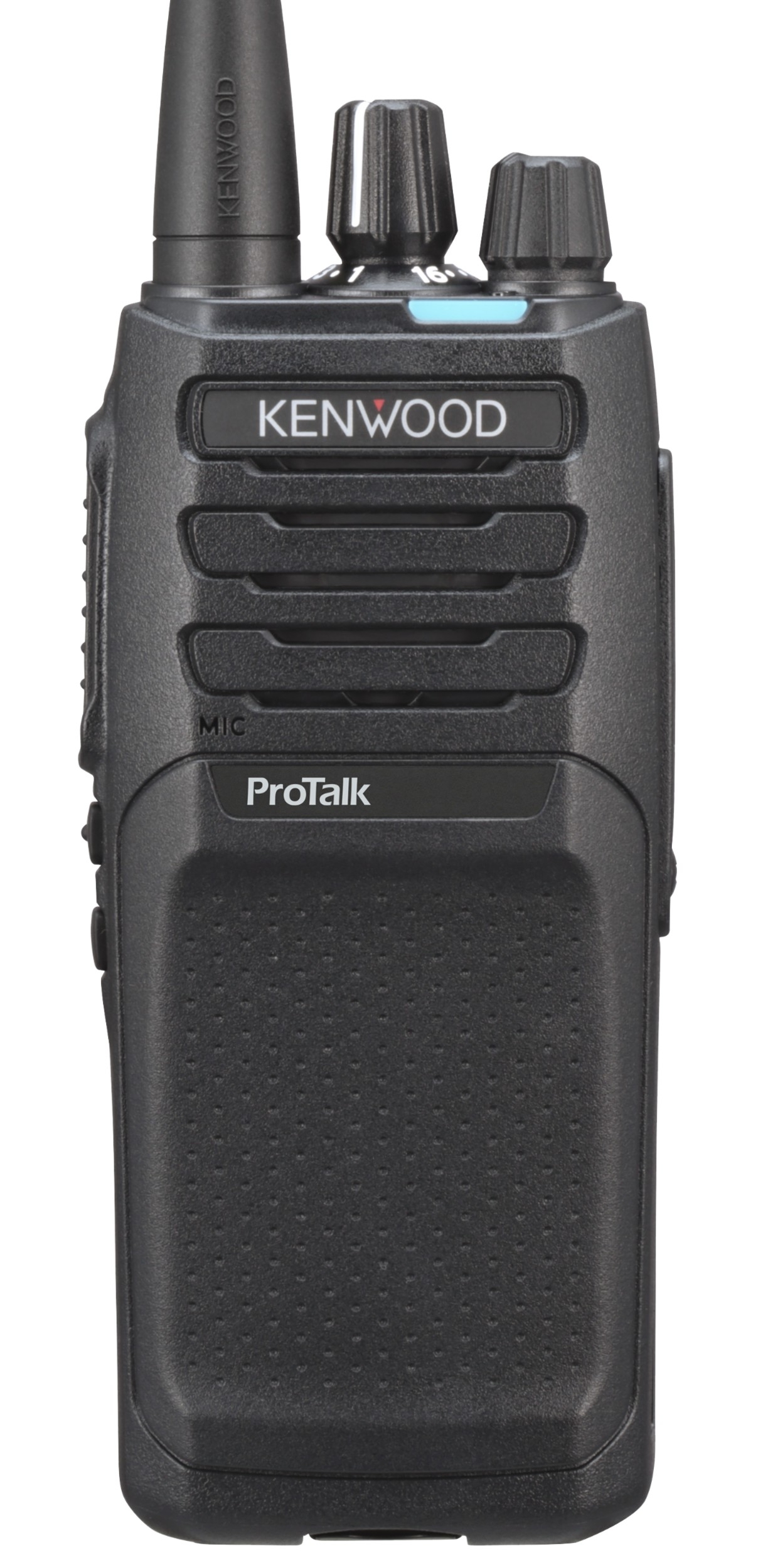
Kenwood Protalk NX-P1300AUK Two-Way Radio - 5W, 64C, Analog, "LOUD" 1000mW Speaker, UHF(450-520MHz) - K01
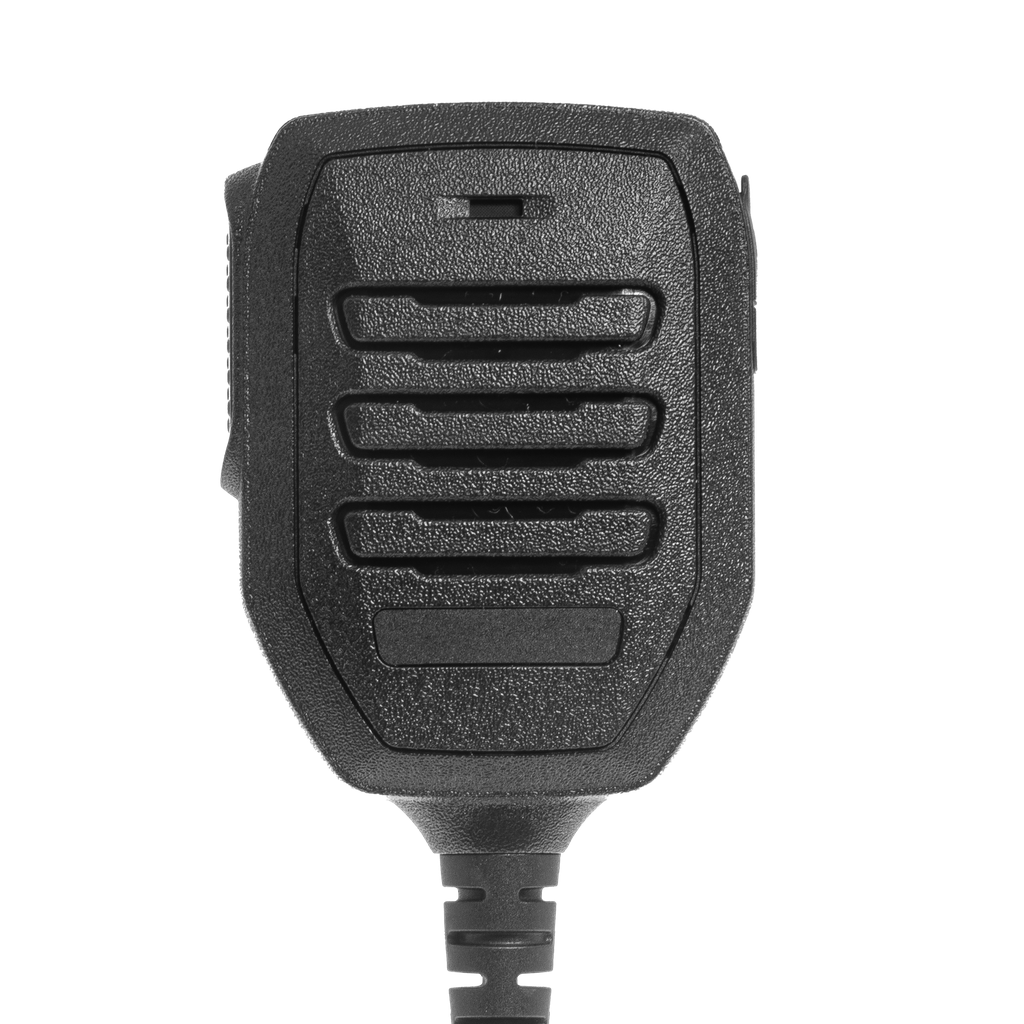
Voiceporter VPS850-K01 Speaker Microphone - LOUD, Heavy Duty, Kevlar, IP68, USA Brand - Kenwood K01
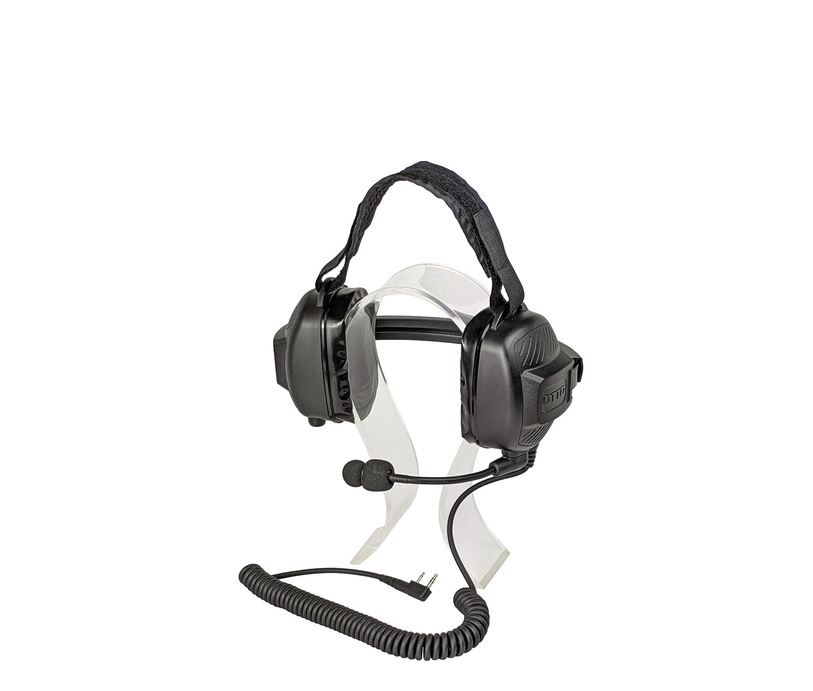
Otto ClearTrak NRX V4-11223-S Headset - 24dB, IS-ATEX, BTH, Earcup PTT - K01
For more on Kenwood Products - https://www.kenwood.com/usa/com/
Partnership Advantage
Rather than guessing at equipment needs, construction project managers work directly with TwoWayRadio.com to properly scope a communication system from the ground up — accounting for site acreage, building layout, elevation changes, crew size, and concurrent user load across active phases of construction.
TwoWayRadio.com's approach is to understand the operational challenges each jobsite presents and engineer a solution around them. For construction environments, that means recommending professional-grade repeater infrastructure and strategically positioned antennas — not simply shipping a bag of radios and leaving critical coverage gaps unanswered across active work zones.
The result is a professional-grade Hytera DMR system that delivers reliable digital communications across every corner of the jobsite — from ground crews and equipment operators to site supervisors and safety personnel — and scales easily as headcount grows, phases expand, or multiple contractors come on site.
TwoWayRadio.com's in-house Design Team provides end-to-end communication solutions without the inflated costs of local dealers who often overprice and over-engineer. TWR brings deep industry expertise and real value to every construction customer — from ground-break to project closeout.

On this page
- Purpose - Best Two-Way Radios for Construction Sites (Field Guide)
- Understand MIL-STD-810
- Understand UHF vs VHF for Construction Sites
- Understand FCC Licensing for Construction
- FCC source:
- 10 Step Two Way Radio Deployment Guide
- What is Rugged Mean for Construction?
- Best Equipment Picks for Construction
- Partnership Advantage