

Motorola BPR 50dX in Steel Manufacturing: A Plant-Wide Communications Case Study
By Bruce Fogelberg - www.twowayradio.com. We are commercial radio experts since 2000. , Two Way Radio Expert
Published: June 12, 2026
Case Study: How a Steel Manufacturing Plant Uses the Motorola BPR 50dX to Improve Plant-Wide Communications
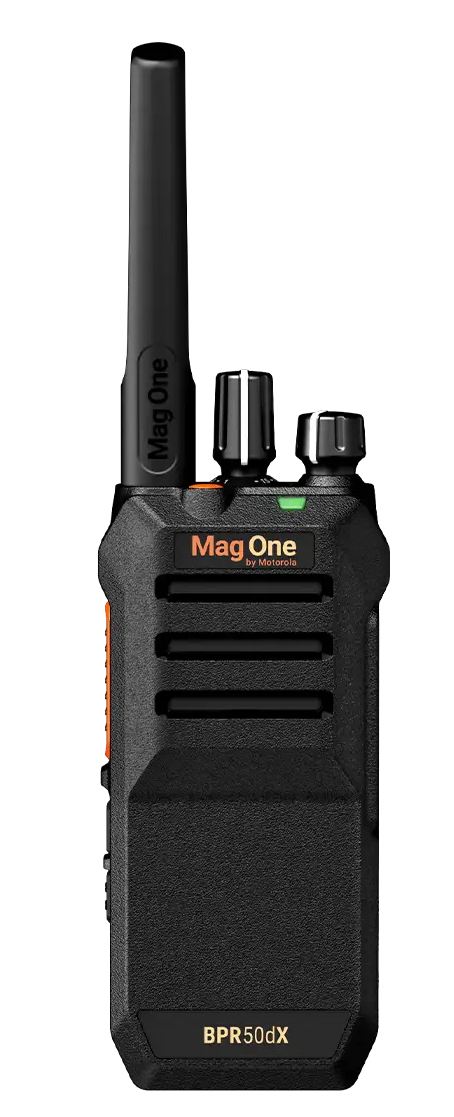
Motorola MagOne BPR50DX Two-Way Radio - 4W, 16C, Analog/DMR, VHF(136-174MHz) - M03N - AAH88LDK8AD5BN
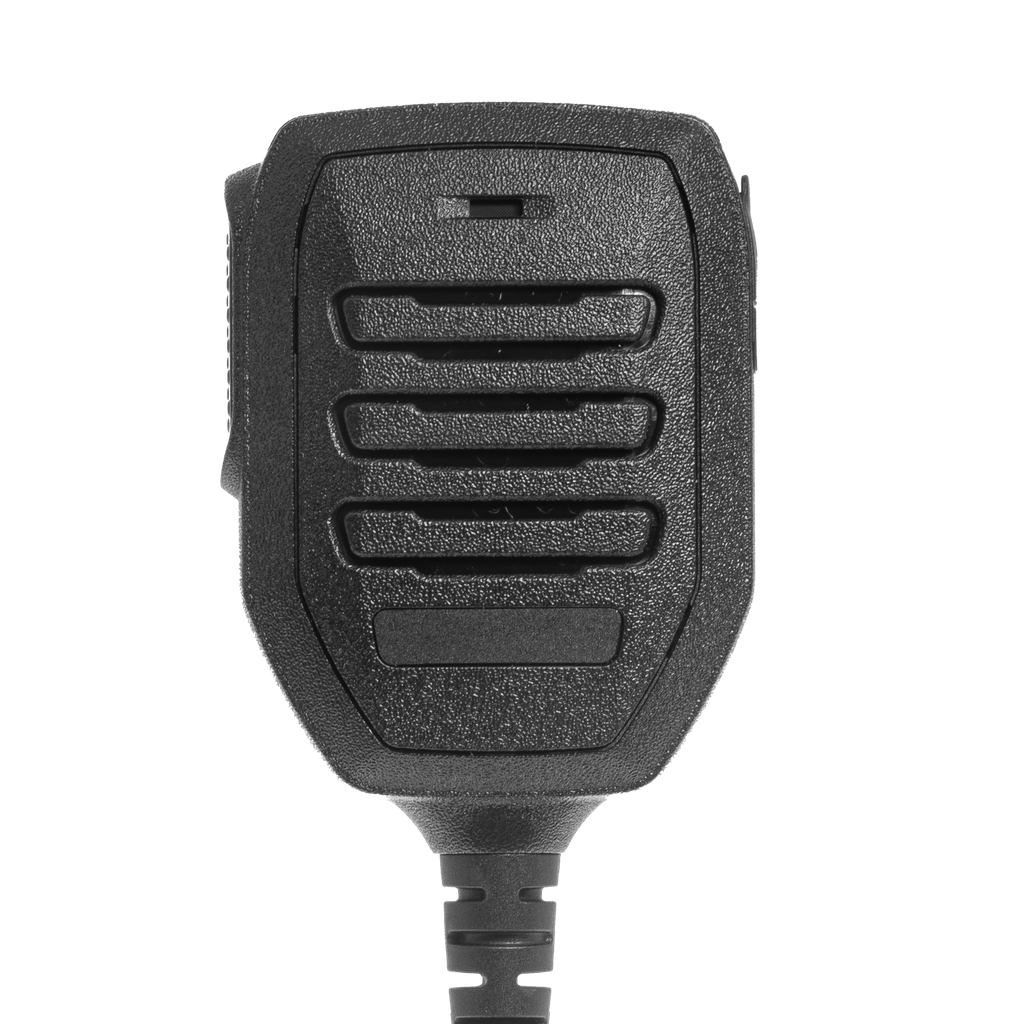
Voiceporter VPS850-M03N Speaker Microphone - LOUD, Heavy Duty, Kevlar, IP68 - Motorola M03N
Note: This is an illustrative use case based on common deployments in steel manufacturing environments, modeled on operations like those of Nucor Corporation, North America's largest steel producer. It is not an official Nucor or Motorola Solutions case study.
The Challenge
Steel manufacturing is one of the most demanding communication environments in American industry. A typical mill campus spans hundreds of acres and includes fabrication bays, rolling operations, scrap yards, shipping and receiving docks, maintenance shops, and administrative offices. Teams are spread across multiple buildings with heavy steel construction, high ambient noise from cranes and processing equipment, and around-the-clock shift schedules.
At a facility of this scale, cell phones fall short. Coverage inside steel-framed buildings is unreliable, calls are one-to-one rather than one-to-many, and a dropped call during a crane lift or truck staging operation is more than an inconvenience. It is a safety issue. Supervisors in fabrication, shipping, and yard operations needed instant group communication that could survive a 12-hour shift, cut through equipment noise, and cover the full footprint of the plant.
The Solution: Motorola BPR 50dX
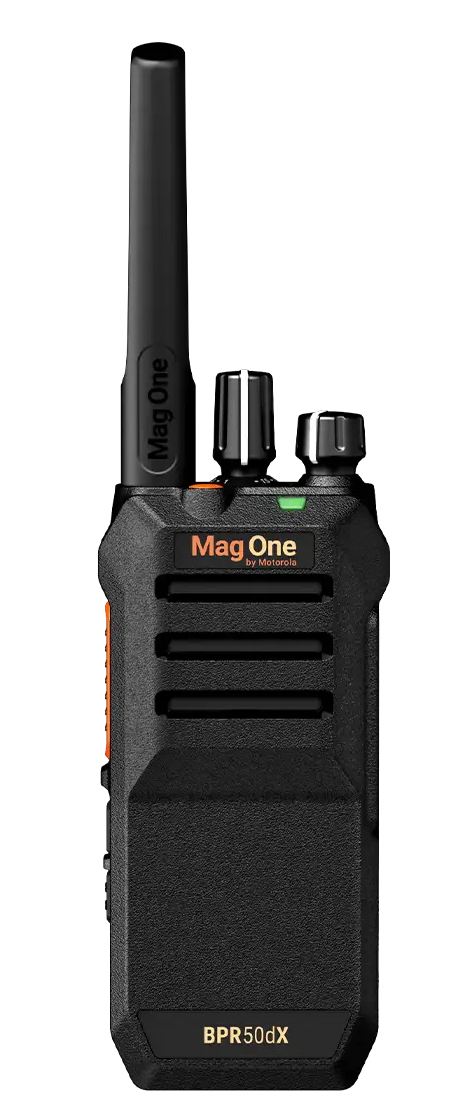
The plant standardized its fabrication, shipping, warehouse, and facilities teams on the Mag One BPR 50dX by Motorola, a licensed portable two-way radio that supports both analog and digital (DMR) operation.
Several capabilities made the BPR 50dX the right fit for this environment.
- 5 watts of transmit power. With up to 5 watts of RF output, the BPR 50dX delivers the range needed to cover a sprawling industrial campus and penetrate multi-story, steel-framed buildings where lower-powered radios and cell phones struggle.
- 3 watts of loud, noise-cancelled audio. The BPR 50dX is the loudest radio in the Mag One family. Combined with noise cancellation, transmissions stay intelligible next to running cranes, forklifts, saws, and material handling equipment.
- 23 hours of battery life. A single charge comfortably outlasts a 12-hour shift with reserve to spare. USB-C charging means a depleted radio can be topped off from any standard USB charger in a break room or truck cab, not just a dedicated drop-in charger.
- Digital DMR migration path. The plant began on its existing analog channels and migrated teams to digital DMR over time, gaining clearer voice at the edge of coverage and interoperability with other DMR radios already in service. Running analog and digital on the same hardware meant no forklift upgrade was required.
- Lone worker and emergency features. Maintenance technicians working alone in remote areas of the yard or in equipment rooms are protected by the radio's lone worker function and dedicated emergency calling. The remote monitor feature lets a supervisor remotely open a radio's microphone to assess a situation if a worker does not respond.
- Built for industrial conditions. With an IP55 rating against dust and water spray, a large textured push-to-talk button usable with gloves, and three programmable buttons for one-touch access to key channels or functions, the radio holds up to daily industrial use.
The Deployment
Radios were organized into talk groups mirroring the plant's operating structure: fabrication, shipping and receiving, yard and crane coordination, maintenance, and facilities. Supervisors carry radios programmed with access to all groups, while line personnel stay on their department channel to keep traffic clean. Remote speaker microphones were issued to crane spotters and dock leads so they could transmit without removing gloves or unclipping the radio.
For the highest-heat, highest-hazard zones such as the melt shop, the plant continues to rely on a separate fleet of ruggedized professional-tier radios. The BPR 50dX fleet handles everything else, which keeps per-unit costs down across the majority of the workforce without compromising where it matters.
The Results
- Faster coordination on the floor. Instant push-to-talk group calls replaced phone tag between shipping, the yard, and fabrication. Truck staging and crane lift coordination that previously took multiple phone calls now happens in a single transmission heard by everyone who needs it.
- Full-shift reliability. The 23-hour battery eliminated mid-shift radio swaps and the spare battery inventory that came with them.
- Improved worker safety. Lone worker monitoring and one-button emergency calling gave maintenance and night-shift personnel a verified safety net, supporting the plant's safety-first culture.
- Lower total cost of ownership. Standardizing support and logistics teams on an affordable licensed radio, while reserving premium radios for hazardous zones, reduced fleet costs without sacrificing coverage or audio quality.
The Bottom Line
For steel producers and heavy manufacturers, the Motorola BPR 50dX hits a practical sweet spot: professional-grade power, audio, and battery life at a business-radio price. It is an ideal fleet radio for fabrication, warehousing, shipping, and facilities teams across large industrial campuses, with a clean digital migration path as operations modernize.
Frequently Asked Questions
Is the Motorola BPR 50dX powerful enough for a large industrial plant?
Yes. The BPR 50dX transmits at up to 5 watts, the maximum typically allowed for portable business radios, giving it the range to cover large campuses and penetrate steel-framed, multi-story buildings. Real-world range depends on terrain, building construction, and frequency band, and very large sites can extend coverage further with a repeater.
Does the BPR 50dX work in high-noise manufacturing environments?
It is well suited to them. The radio delivers 3 watts of audio output, the loudest in the Mag One family, plus noise cancellation that keeps voice transmissions clear next to cranes, forklifts, and processing equipment. Pairing it with a remote speaker microphone or noise-isolating headset improves performance further in extreme noise.
Is the BPR 50dX analog or digital?
Both. It operates in analog mode and in digital DMR (Digital Mobile Radio) mode, and it interoperates with other DMR radios. This lets a plant keep using existing analog channels today and migrate to digital over time without replacing hardware.
Do I need an FCC license to use the BPR 50dX?
Yes. The BPR 50dX is a licensed business radio, which means your organization needs an FCC Part 90 business license to operate it legally in the United States. Licensing gives you dedicated frequencies with less interference than license-free options. A radio dealer can typically assist with the licensing process.
How long does the battery last on the BPR 50dX?
Up to 23 hours of talk time on a single charge, which comfortably covers a 12-hour industrial shift. It charges via a single-unit drop-in charger or any standard USB-C charger.
What safety features does the BPR 50dX include for industrial workers?
The radio includes lone worker monitoring, which requires periodic check-ins from employees working alone, an emergency call function for one-button alerts, and remote monitor, which allows a supervisor to remotely activate a radio's microphone to listen in during a non-response situation.
Is the BPR 50dX durable enough for a steel mill or factory floor?
The BPR 50dX carries an IP55 rating, meaning it is protected against dust ingress and water jets, and it features a large, textured push-to-talk button designed for gloved hands. For the most extreme environments, such as melt shops or areas requiring intrinsically safe equipment, a professional-tier radio like the MOTOTRBO series is the better fit.
How many channels does the BPR 50dX support, and can teams be separated?
The radio supports multiple channels that can be organized into department talk groups, such as shipping, maintenance, fabrication, and facilities, so each team communicates without cross-traffic while supervisors can monitor or access all groups.
What accessories work with the BPR 50dX?
Common pairings include the Mag One Breeze remote speaker microphone, ear receivers and earbuds with in-line PTT, surveillance kits, and multi-unit chargers. Remote speaker mics are especially popular in industrial settings where workers need to transmit without unclipping the radio.
How does the BPR 50dX compare to the older BPR40?
The BPR 50dX adds digital DMR capability, dramatically longer battery life (up to 23 hours), louder 3-watt audio with noise cancellation, USB-C charging and programming, IP55 dust and water resistance, and safety features like lone worker and emergency calls — a substantial upgrade over the analog-only BPR40.