

Motorola BPR50dX vs CP100d vs R2 vs R5: Which UHF Two-Way Radio Fits Your Team?
By Bruce Fogelberg - www.twowayradio.com. We are commercial radio experts since 2000. , Two Way Radio Expert
Published: September 23, 2026
Last updated: October 14, 2026
On this page
- Where each radio sits in Motorola’s lineup?
- Motorola UHF radio comparison: specs at a glance
- Motorola BPR50dX: the value radio for simple push-to-talk
- Motorola CP100d: the entry point to MOTOTRBO
- Motorola R2: the everyday workhorse
- Motorola R5
- Head-to-head: the comparisons buyers ask about most
- How to choose: the six factors that decide it
- Best Motorola radio by industry
- Can these radios work together?
- Cost of ownership: look beyond the sticker price
- Frequently asked questions:
Where each radio sits in Motorola’s lineup?
The easiest way to understand these four radios is as a ladder. Each step up adds durability, audio performance and system capability—and each one is the current replacement for a well-known discontinued model, which matters if you’re refreshing an existing fleet.
Motorola BPR50dX vs CP100d vs R2 vs R5: Which UHF Two-Way Radio Fits Your Team?

Motorola sells four UHF portables that look similar on a shelf but are built for very different jobs. All four transmit at 4 watts, run both analog and DMR digital, and use the same AMBE+2 digital vocoder—so on paper they can seem interchangeable. The differences show up in the places that matter on a shift: how loud the speaker is next to a forklift, whether the radio survives a drop in a puddle, how long the battery lasts in January, and whether the radio can grow with your system.
Quick Guide:
Buy the BPR50dX for retail, hospitality and schools on a tight budget—it’s the most affordable way into digital, with USB-C charging and a 23-hour battery.
*
Buy the CP100d if you want the lowest-cost MOTOTRBO radio, or a display model with up to 160 channels.
*
Buy the R2 as the everyday workhorse for warehouses, facilities and light construction.
*
Buy the R5 for loud, wet, dusty or hazardous sites, Bluetooth accessories, or multi-site systems—it’s the only one of the four with IP67 and an intrinsically safe option.
*
This guide compares the Motorola Mag One BPR50dX, MOTOTRBO CP100d, MOTOTRBO R2 and MOTOTRBO R5 side by side, explains which spec differences actually change the buying decision, and matches each radio to the industries and environments it suits best.
Key takeaways:
All four are dual-mode analog/DMR digital radios, so any of them can join an existing analog fleet and migrate to digital at your own pace.
*
Durability steps up with price: IP54 (CP100d) → IP55 (BPR50dX, R2) → IP67 submersible (R5)
*
The R5 is the only model with Bluetooth, Wi-Fi, a 5-year included service term, an intrinsically safe (UL/TIA-4950) option and multi-site system support.
*
For pure battery runtime on standard batteries, the BPR50dX (23 hrs) and R2 (22.5 hrs) lead; the R5 pulls ahead only with its 3200 mAh high-capacity pack (30 hrs UHF).
*
For cold climates, note the CP100d’s Li-Ion battery is rated down to 14°F, while the other three are rated to –4°F.
Motorola UHF radio comparison: specs at a glance
The table below compares the UHF versions of each radio using Motorola’s published North America specifications. Battery life figures use Motorola’s standard 5/5/90 duty cycle (5% transmit, 5% receive, 90% standby) at high power.

Motorola BPR50dX: the value radio for simple push-to-talk
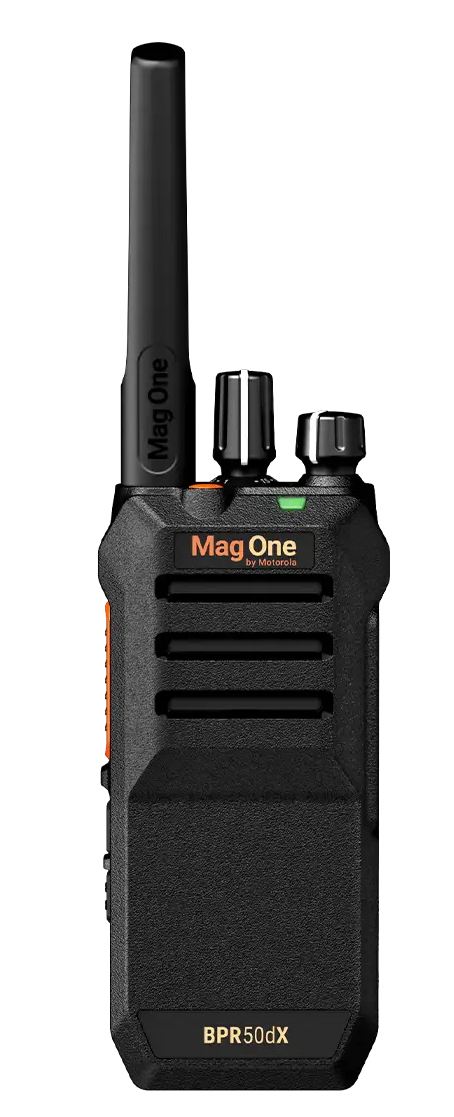
Motorola MagOne BPR50DX Two-Way Radio - 4W, 16C, Analog/DMR, UHF(403-480MHz) - M03N - AAH88SCK8AD5BN
Mag One BPR50dX — the analog-to-digital bridge for budget-conscious teams
The BPR50dX is the successor to the long-running Mag One BPR40 and BPR40d. It keeps the simple, no-display, turn-a-knob operation that retail and hospitality staff learn in seconds, and adds features that used to be reserved for more expensive radios: a dedicated emergency button, Lone Worker, Remote Monitor and a 3-watt maximum speaker output that Motorola calls the loudest in the Mag One family.
Its standout convenience feature is USB-C charging and programming directly on the radio. Motorola notes that USB-C charging is roughly 30% slower than the desktop charger, but it means a staff member can top up from any USB charger in a break room or vehicle.
BPR50DX - Strengths
23 hours of digital talk time on the standard battery—the longest standard-battery runtime in this comparison.
IP55 and MIL-STD-810 C–H: rated for rain and dust, and tested to the same military standard revisions as the R2 and R5.
64 channels across 4 zones (16 channels per zone), plus 3 programmable buttons.
Works with existing Mag One audio accessories from the BPR40d, which lowers upgrade cost.
BPR50DX - Limitations
No display—channel changes rely on the knob and voice announcements.
Not a MOTOTRBO radio: no Capacity Plus, IP Site Connect or multi-site support.
Privacy is limited to analog scrambling; not a fit where encrypted-style digital privacy is required.
No Bluetooth and no intrinsically safe option.
BPRDX50 Best for
Retail stores, hotels and restaurants, K-12 schools, property management and light facilities work—teams that need reliable, simple push-to-talk and long battery life at the lowest cost per radio. It’s also a smart way to replace BPR40/BPR40d radios gradually while keeping accessories.
Current BPRUHF model numbers
AAH88SCK8AD5BN
UHF 400–470 MHz, no display, 4 W, 64 channels, analog + DMR digital
Motorola CP100d: the entry point to MOTOTRBO
MOTOTRBO
CP100D
— lowest-cost MOTOTRBO, with the only display option under the R5
The CP100d is Motorola’s entry-level MOTOTRBO portable and the replacement for the CP185. Its biggest differentiator in this group is choice: it comes as a 16-channel non-display radio or as a 160-channel display model with a limited or full keypad. If your users need to read channel names or pick from a large channel plan without a zone chart, the CP100d is the least expensive way to get a screen.
Motorola also sells an analog-only CP100d that can be upgraded to digital later with a software license—useful when you need to buy radios now but aren’t ready to move the whole fleet to DMR.
CP100D - Strengths
Display/keypad versions with 160 channels—more channels than the BPR50dX or R2.
Analog-only version with a software upgrade path to digital.
Dual Capacity Direct Mode doubles talk paths on one 12.5 kHz licensed channel without a repeater.
Pre-programmed text messages and voice announcements.
CP100 D - Limitations
IP54 is the lowest ingress rating here: splash- and dust-resistant, not built for sustained rain or washdown.
Shortest standard-battery runtime (14.4 hrs digital) and the lowest rated speaker output (0.5 W).
Li-Ion battery rated only to 14°F (–10°C)—a real consideration for outdoor winter use in northern climates.
No Bluetooth, no multi-site system support, no intrinsically safe option.
CP100D - Best for
Hotels, schools, event venues and light warehousing where cost-per-radio drives the decision and users work mostly indoors. Choose a display model when supervisors or security staff need many channels and want to see where they are.
Current CP100 UHF model numbers
AAH87YDC9JA2AN
Non-display, 16 channels, analog + DMR digital
*
AAH87YDC9JC2AN
Non-display, 16 channels, analog only (upgradeable to digital)
*
AAH87YDH9JA2AN
Display / limited keypad, 160 channels, analog + DMR digital
*
AAH87YDF9JA2AN
Display / full keypad, 160 channels, analog + DMR digital
Motorola R2: the everyday workhorse
Motorola R2
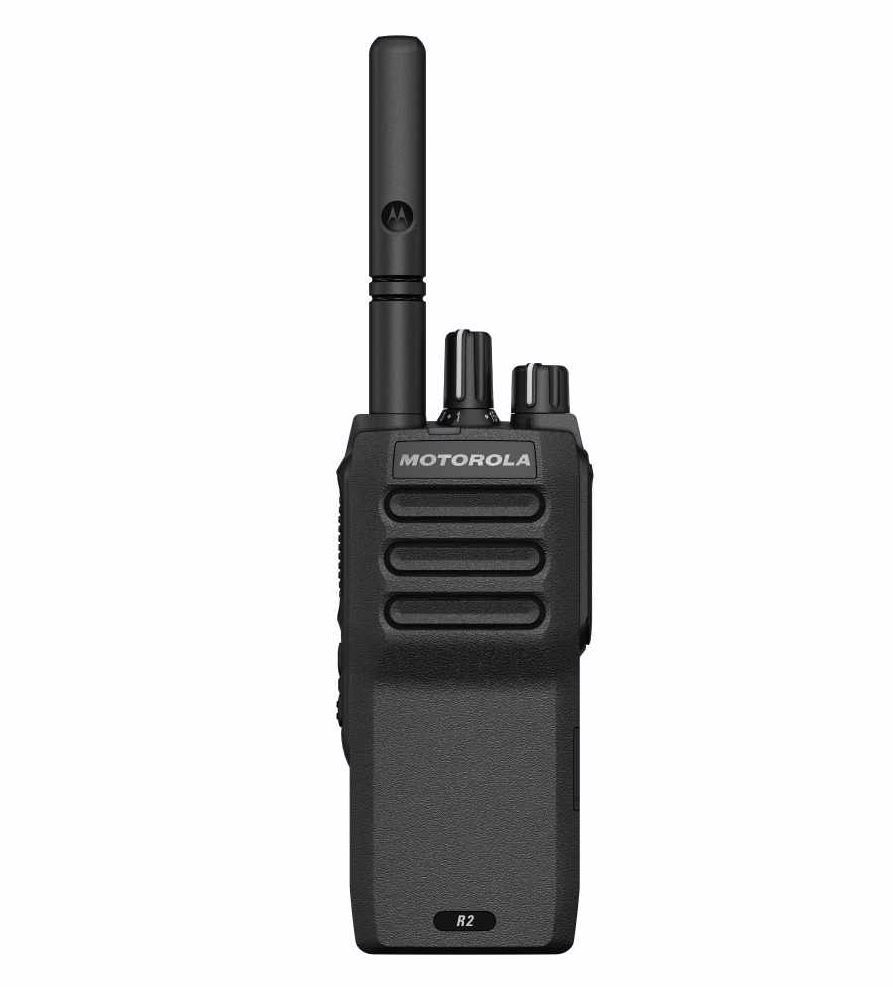
R2 is the CP200d replacement and the right default for most fleets
The R2 took over from the CP200d, one of the most widely deployed commercial radios Motorola ever sold, and it’s the model we’d point most commercial buyers to first. It pairs a slim 9.2 oz body with loud 101-phon audio, SINC+ noise suppression and acoustic feedback suppression—noticeably better in noisy spaces than the entry models.
Battery life is excellent: 22.5 hours in digital on the slim battery and 26.5 hours on the high-capacity pack. The R2 also adds Extended Range Direct Mode, which improves radio-to-radio coverage when you don’t have a repeater, and Enhanced Privacy for digital voice.
R2 - Strengths
Loud audio (101 phons) with noise and feedback suppression—well suited to moderately noisy floors.
Best-in-group standard-battery runtime among MOTOTRBO models (22.5 hrs digital).
IP55 and MIL-STD-810 C–H durability; lightest radio in this comparison.
Enhanced Privacy, Transmit Interrupt decode, secure Linux OS and radio/repeater authentication.
R2- Limitations
Single-site conventional only—no Capacity Plus, IP Site Connect or multi-site trunking.
No display option, no Bluetooth, and no intrinsically safe version.
IP55 handles rain and dust but is not rated for immersion.
R2 - Best for
Warehouses and distribution centers, manufacturing floors, facilities and maintenance teams, security, landscaping and light construction—any team that needs a durable, loud, long-running standard-issue radio on a single site.
R2 Current UHF model numbers
AAH11YDC9JA2AN
Non-display, 64 channels, analog + DMR digital
*
AAH11YDC9JC2AN
Non-display, 64 channels, analog only (upgradeable to digital)
Motorola R5
The professional-tier radio for demanding work
MOTOTRBO R5 — IP67, Bluetooth, Wi-Fi, intrinsically safe option and multi-site systems
The R5 replaces the XPR 3300e and XPR 3500e and is the only radio in this group built for truly harsh or safety-critical environments. It’s IP67 dust-tight and waterproof, tested to MIL-STD-810H, and available in an intrinsically safe configuration certified to UL/TIA-4950 and CSA C22.2 when paired with Motorola’s PMNN4890 battery.
Audio is its other headline: AI-trained noise suppression, SINC+ and Intelligent Audio, with loudness programmable up to 106 phons. Built-in Bluetooth 5.2 supports wireless headsets and data devices, while Wi-Fi enables over-the-air software updates. Motorola includes 5 years of hardware repair, technical support and software updates.
R5 - Strengths
IP67 submersion rating—the only radio here that can survive a dunk or washdown.
Intrinsically safe option for Class I, II, III Division 1 hazardous locations (Groups C, D, E, F, G) and Division 2 (Groups A, B, C, D).
Up to 30 hours digital (UHF) with the 3200 mAh IMPRES battery.
System growth: supports IP Site Connect and Capacity Plus single- and multi-site trunking.
Display model with 256 channels across 50 zones; best receiver sensitivity in the group.
R5 -Limitations
Highest price in this comparison.
On the standard 2200 mAh battery, UHF runtime (20 hrs digital) is shorter than the R2 or BPR50dX—budget for high-capacity batteries on long shifts.
Intrinsically safe certification applies only with the approved IS battery and IS-configured model.
Advanced system features may require licenses—confirm with your dealer.
R5 - Best for
Construction, heavy manufacturing, utilities, oil and gas, chemical plants, mining, ports and large logistics operations—anywhere radios face water, dust, extreme noise, hazardous atmospheres, or need to roam across multiple sites.
Current R5 UHF model numbers
AAH07RDC9SA1AN
Non-display (no keypad), 64 channels, Wi-Fi / Bluetooth
*
AAH07RDH9SA1AN
Display / limited keypad, 256 channels, Wi-Fi / Bluetooth
*
AAH07RDC9SA1AN-IS
Non-display, intrinsically safe (requires UL/TIA-4950-approved PMNN4890 battery)
An intrinsically safe version of the display/limited-keypad UHF R5 is also offered; confirm the current part number with your dealer, as listings vary.
Head-to-head: the comparisons buyers ask about most
BPR50dX vs CP100d
Choose the BPR50dX if you want longer battery life (23 vs 14.4 hours digital), better weather resistance (IP55 vs IP54), a louder speaker, USB-C charging and an emergency button. Choose the CP100d if you need a display, more than 64 channels, or want to stay inside the MOTOTRBO product family. For most non-display users, the BPR50dX is the stronger radio for the money.
CP100d vs R2
The R2 is the clear upgrade: louder 101-phon audio with SINC+ noise suppression, IP55, lighter weight, a battery that runs 22.5 hours versus 14.4, Enhanced Privacy and Extended Range Direct Mode. The CP100d only wins if you need a display or 160 channels, or if price per radio is the overriding factor.
R2 vs R5
Buy the R2 if you’re on one site, your radios live indoors or in moderate weather, and you don’t need wireless accessories. Step up to the R5 if you need IP67 waterproofing, an intrinsically safe radio, Bluetooth headsets, a display, multi-site or trunked systems, or the 5-year included service term. On the standard battery the R2 actually runs longer; the R5 leads only with its high-capacity pack.
How to choose: the six factors that decide it
1. Environment: what the IP rating really means
The second digit of an IP rating describes water protection. IP54 (CP100d) resists splashing, IP55 (BPR50dX, R2) resists water jets like heavy rain, and IP67 (R5) survives temporary immersion. If radios work outdoors, near washdown areas or around water, the R5 is the only choice built for it.
2. Noise: phons and noise suppression
Phons measure perceived loudness. The R2 (101 phons) and R5 (up to 106 phons) are specified for loud environments, and the R5 adds AI-trained noise suppression that filters machinery and crowd noise out of the transmitting user’s voice. In a quiet hotel or store, the BPR50dX or CP100d is plenty; next to presses, compressors or heavy equipment, go R2 or R5.
3. Battery life and cold weather
For a single 8–12 hour shift, all four radios are fine with the right battery. For double shifts or no mid-shift charging, the BPR50dX (23 hrs) and R2 (22.5 hrs) lead on standard batteries, and the R5 reaches 30 hours with its 3200 mAh pack. In cold climates, remember that battery ratings—not radio ratings—set the limit: the CP100d’s Li-Ion battery is rated to 14°F, the others to –4°F.
4. Hazardous locations
If your workers enter areas with flammable gases, vapors or combustible dust, you need a radio certified as intrinsically safe for that classification. Only the R5 offers this, and only in its IS configuration with the approved PMNN4890 battery. Never substitute a non-IS battery on an IS radio.
5. System size and future growth
If your radios talk direct or through one repeater, any of the four will work. If you plan to link multiple sites, add trunking for more users, or roam across a campus, the R5 is the only one of these four that supports IP Site Connect and Capacity Plus.
6. Accessories and fleet management
The R5’s Bluetooth supports wireless headsets and data devices, and Wi-Fi allows over-the-air software updates—big time-savers for large fleets. The BPR50dX reuses Mag One accessories from the BPR40d, and the R5 works with XPR 3500-series audio accessories, antennas and chargers (but not XPR batteries), which can cut upgrade costs.
Best Motorola radio by industry
Retail stores
BPR50dX
CP100d
Simple, long battery, USB-C, low cost
*
Hotels & hospitality
BPR50dX
CP100d (display)
Quiet indoor use; display helps supervisors
*
K-12 schools & campuses
BPR50dX
R2
Emergency button, Lone Worker, budget-friendly
*
Event venues & security
R2
CP100d (display)
Loud audio in crowds; privacy
*
Warehousing & distribution
R2
R5
Noise suppression, IP55, full-shift battery
*
Manufacturing
R2
R5
R5 for heavy noise or washdown areas
*
Construction
R5
R2
IP67, loudest audio, Bluetooth headsets
*
Utilities & public works
R5
Weather, multi-site systems, 5-year service
*
Oil & gas, chemical, mining
R5 (IS)
Only intrinsically safe option
*
Property & facilities management
BPR50dX
R2
R2 if mechanical rooms or outdoor work
Can these radios work together?
Yes. All four are analog/DMR Tier II radios using the AMBE+2 vocoder, so they can share analog channels and communicate in DMR digital mode when programmed with matching frequencies, color codes and talkgroups. That makes a mixed fleet practical—for example, R5s for a maintenance crew and BPR50dXs for front-of-house staff on the same system.
Two cautions: keep privacy settings consistent across the fleet (the BPR50dX and CP100d don’t support Enhanced Privacy), and remember that system-level features like Capacity Plus are only available to radios that support them. Have your dealer build one code plug plan across all models.
Cost of ownership: look beyond the sticker price
Radio price rises in the order BPR50dX, CP100d, R2, R5, but lifetime cost depends on more than the purchase. Factor in batteries (plan for replacements every two to three years on heavy-use fleets), chargers, audio accessories and service coverage. The R5’s included 5-year hardware repair and software updates can offset part of its higher upfront price for organizations that keep radios in service five years or longer.
Frequently asked questions:
Which Motorola radio replaced the CP200d?
The MOTOTRBO R2 replaced the CP200d. It keeps a similar size and price position while adding louder 101-phon audio, SINC+ noise suppression, IP55 protection and up to 22.5 hours of digital battery life on the standard slim battery.
What replaced the Motorola XPR 3300e and XPR 3500e?
The MOTOTRBO R5 is the replacement for both. It adds IP67 waterproofing, AI-trained noise suppression, Bluetooth 5.2, Wi-Fi, and 5 years of included hardware repair and software updates, and it works with XPR 3500-series audio accessories, antennas and chargers.
Is the Motorola R2 waterproof?
No. The R2 is rated IP55, which protects against dust and water jets such as heavy rain, but it is not rated for submersion. If you need a waterproof Motorola radio, the R5 is rated IP67 for temporary immersion.
Which Motorola radio has the longest battery life?
On standard batteries, the BPR50dX leads at 23 hours digital, followed closely by the R2 at 22.5 hours. With its 3200 mAh high-capacity battery, the UHF R5 reaches 30 hours digital—the longest in this group.
Can the BPR50dX talk to MOTOTRBO radios?
Yes. The BPR50dX is a DMR Tier II radio, so it can communicate with MOTOTRBO radios like the CP100d, R2 and R5 in digital mode when programmed with matching frequencies, color codes and talkgroups. It also works in analog mode with older radios.
Do I need an intrinsically safe radio?
You need one if workers enter areas classified as hazardous locations where flammable gases, vapors or combustible dust may be present. Among these four models, only the R5 offers an intrinsically safe version, certified when used with Motorola’s approved PMNN4890 battery.
What’s the difference between the CP100d and the R2?
The R2 is louder (101 phons), more rugged (IP55 vs IP54), lighter and runs much longer (22.5 vs 14.4 hours digital). The CP100d’s advantages are its lower price and the option of a display model with 160 channels.
Which of these radios has Bluetooth?
Only the R5. It supports Bluetooth 5.2 for one wireless audio accessory and up to four data devices, plus Wi-Fi for over-the-air software updates. The BPR50dX, CP100d and R2 require wired accessories.
Do I need an FCC license for these radios?
Yes. All four are Part 90 business radios that operate on licensed UHF frequencies in the US. Your dealer can help you apply for a license or program the radios to frequencies your organization already holds.
Ready to choose?
Motorola MagOne BPR50DX Two-Way Radio - 4W, 16C, Analog/DMR, UHF(403-480MHz) - M03N - AAH88SCK8AD5BN

Motorola CP100D-UHF-DMR-LKP Two-Way Radio - 4W, 160C, UHF(403-480MHz), LCD, LKP, Analog/DMR - AAH87YDH9JA2AN - M03N

Motorola MotoTRBO R2-UHF-DMR Two-Way Radio - 4W, 64C, Analog/DMR, NKP, UHF(400-480MHz) - AAH11YDC9JA2AN - M03N
Compare pricing and configurations contact www.TwoWayRadio.com, or talk to a radio specialist about programming, licensing and accessories for your fleet.
general@twowayradio.com, or 651.379.9260
On this page
- Where each radio sits in Motorola’s lineup?
- Motorola UHF radio comparison: specs at a glance
- Motorola BPR50dX: the value radio for simple push-to-talk
- Motorola CP100d: the entry point to MOTOTRBO
- Motorola R2: the everyday workhorse
- Motorola R5
- Head-to-head: the comparisons buyers ask about most
- How to choose: the six factors that decide it
- Best Motorola radio by industry
- Can these radios work together?
- Cost of ownership: look beyond the sticker price
- Frequently asked questions: