

What is the difference between UHF and VHF radios?
By Bruce Fogelberg - www.twowayradio.com. We are commercial radio experts since 2000. , Two Way Radio Expert
Published: September 17, 2026
Last updated: September 18, 2026
What is the difference between UHF and VHF radios?
Review the FCC.GOV site as well >> https://www.fcc.gov/uhfvhf-bands
The Core Difference
The fundamental distinction is in the wavelength and how each frequency band interacts with the physical environment.
VHF (Very High Frequency) operates between 136–174 MHz, producing longer wavelengths that travel farther in open spaces but struggle to penetrate solid objects.
UHF (Ultra High Frequency) operates between 400–512 MHz (and up to 700+ MHz in some systems), with shorter wavelengths that are much better at bouncing around and penetrating walls, buildings, and dense terrain.
Key Technical Differences
Range in open terrain — VHF wins here. Its longer wave propagates efficiently across flat, open land and can cover significantly greater distances with the same power output. A VHF radio in an open field will often outperform a UHF radio.
Penetration and indoor performance — UHF wins decisively. Shorter wavelengths diffract and reflect around obstacles more effectively. In a concrete building, a UHF signal that would be completely blocked for VHF can still bounce through corridors and stairwells and reach the recipient.
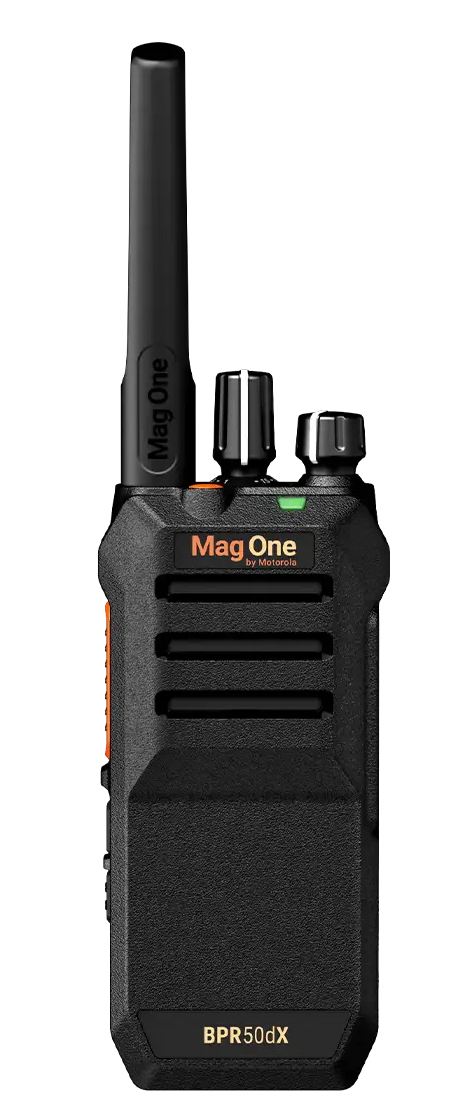
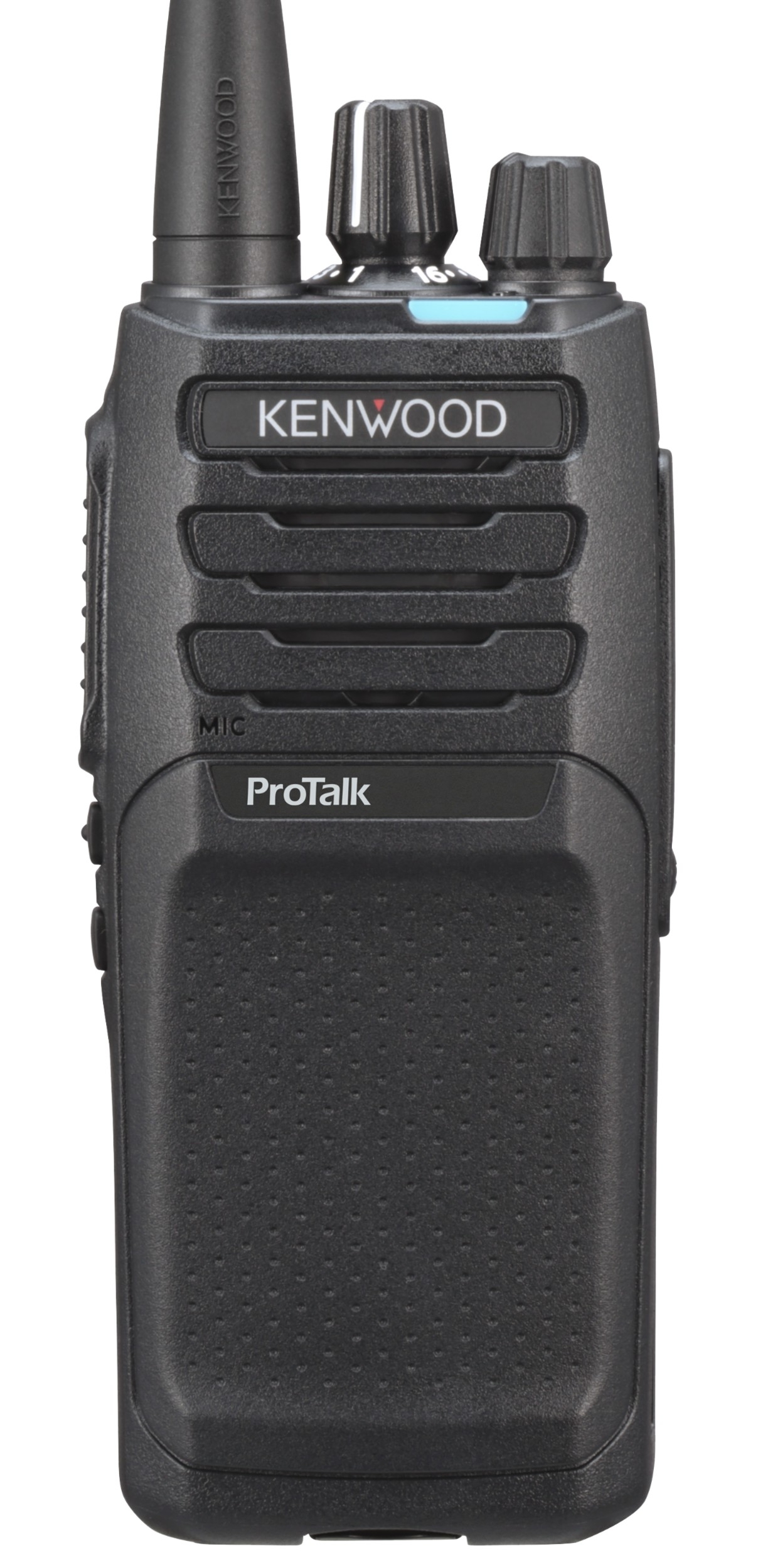
Antenna size — VHF antennas are physically longer due to their longer wavelength. UHF radios tend to be more compact and ergonomic as a result.
Interference — VHF is more susceptible to interference from environmental sources. UHF's higher frequency gives it a cleaner signal in electrically noisy environments.
Battery and power efficiency — Both are comparable at equivalent power levels, though VHF radios sometimes need less power to achieve similar open-range results.
Licensing — Both typically require FCC licensing for business use in the US (Part 90), though license-free options exist in both bands (GMRS/FRS for UHF, MURS for VHF).
Industry Use Cases

VHF is preferred in:
Agriculture and farming — Wide open fields and rural land benefit from VHF's superior open-terrain range. Farm workers spread across hundreds of acres communicate reliably without repeaters.
Forestry and wildlife management — Rangers and forestry crews operating in heavy tree cover (dense foliage actually absorbs UHF more than VHF) rely on VHF. Trees and vegetation are less of an obstacle for longer wavelengths.
Marine and maritime — The entire marine radio band is VHF (156–174 MHz). Open water is the ideal environment for VHF propagation, and the international maritime standard (VHF Ch. 16) is built on this band.
Aviation — Aircraft communication is VHF (108–136 MHz for nav, 118–136 MHz for voice). Line-of-sight from altitude combined with open sky makes VHF ideal.
Outdoor events and large venues — Music festivals, NASCAR events, and outdoor stadiums spread across open land lean toward VHF for their coordination teams.
Military field operations — Long-range ground-to-ground communication in open or rural environments often uses VHF tactical radios.

UHF is preferred in:
Construction — Workers moving between floors, inside concrete structures, and around heavy machinery need UHF's penetration capability. It's the dominant choice on job sites.
Hospitality and property management — Hotels, resorts, and large facilities rely on UHF to keep housekeeping, security, and maintenance connected across multiple floors and interior spaces.
Healthcare and hospitals — Thick walls, lead-lined rooms, and metal equipment make UHF essential. Most hospital radio systems are UHF.
Retail and warehousing — Big-box stores and distribution centers with metal shelving, concrete floors, and dense racking require UHF to stay connected across the floor.
Public safety and law enforcement — Most modern police, fire, and EMS systems operate on UHF or 700/800 MHz bands, often trunked, because first responders need to work indoors and in urban environments.
Manufacturing and industrial plants — Factory floors full of metal machinery, conveyor systems, and reinforced walls are UHF territory.
Education — School campuses with multiple buildings, hallways, and interior spaces are typically served by UHF systems.
Transportation hubs — Airports (ground operations, not aviation), train stations, and bus depots use UHF for their operations teams navigating inside terminals.
Quick Use Case Decision Guide
If your operation is primarily outdoors and open, go VHF.
If your operation is primarily indoors, urban, or involves moving between buildings, go UHF.
If you need both, many organizations run dual-band systems or use repeaters to extend coverage regardless of band.
Wavelength Deep Dive: VHF vs UHF
Understanding Wavelength Fundamentals
Wavelength is the physical distance a radio wave travels to complete one full cycle — from peak to trough and back to peak again. It's calculated using the formula λ = c / f, where λ is wavelength, c is the speed of light (approximately 300,000,000 meters per second), and f is the frequency in Hz. As frequency goes up, wavelength goes down — they are inversely proportional.
VHF Wavelength in Detail
VHF occupies 136–174 MHz for land mobile radio. Plugging those numbers into the formula:
At 136 MHz (low end): 300,000,000 / 136,000,000 = approximately 2.21 meters (about 7.2 feet)
At 174 MHz (high end): 300,000,000 / 174,000,000 = approximately 1.72 meters (about 5.6 feet)
So a VHF radio wave is physically between roughly 1.7 and 2.2 meters long — comparable to the height of a human being. This is not a trivial size. The wave itself is large enough that many common obstacles — a wall, a car, a person — are actually smaller than or roughly equal to the wavelength. This is part of why VHF diffracts (bends around objects) so well in open terrain and why its ground wave can follow the curvature of the earth to some degree over flat land.
The quarter-wave antenna for VHF, which is the standard for portable radios, would be roughly 43–55 cm long (17–22 inches). This is why VHF antennas are noticeably long and whip-like. A full half-wave antenna would be nearly a meter long, which is impractical for handheld use, so VHF portables typically use shortened or helical antennas with some efficiency trade-off.
The large wavelength also means that VHF energy interacts differently with the ionosphere. At the lower end of VHF, some skywave propagation (bouncing off the ionosphere) is occasionally possible under certain atmospheric conditions, extending range dramatically but unpredictably — a phenomenon called tropospheric ducting or sporadic-E propagation. This does not happen reliably at UHF.
UHF Wavelength in Detail
UHF for land mobile occupies 400–512 MHz, with public safety systems extending into 700–800 MHz.
At 400 MHz (low end): 300,000,000 / 400,000,000 = approximately 0.75 meters (about 2.5 feet)
At 512 MHz (mid/high end): 300,000,000 / 512,000,000 = approximately 0.585 meters (about 23 inches)
At 700 MHz (public safety): 300,000,000 / 700,000,000 = approximately 0.43 meters (about 17 inches)
At 800 MHz: 300,000,000 / 800,000,000 = approximately 0.375 meters (about 15 inches)
So UHF wavelengths range from roughly 37 cm to 75 cm — smaller than a typical human torso. The quarter-wave antenna at UHF is only about 9–19 cm (3.5–7.5 inches), which is why UHF handheld radios have those short, stubby antennas and feel more compact and practical to carry.
Because the wavelength is shorter than or comparable to the size of many building materials and structural features — door frames, window openings, concrete block dimensions, metal conduit spacing — UHF waves interact with these structures through a process of reflection, diffraction, and scattering rather than simply being blocked or passing through. The wave essentially finds its way around and through gaps by bouncing. In a hallway or stairwell, UHF energy ricochets and propagates in ways that VHF simply cannot replicate at indoor scales.
How Wavelength Physically Explains Behavior
Diffraction around obstacles — A wave diffracts most effectively when the obstacle it encounters is comparable to or smaller than its own wavelength. VHF's 2-meter wavelength diffracts well around hills, terrain features, and large outdoor obstacles. UHF's shorter wavelength diffracts better around indoor-scale obstacles like door frames and corners.
Penetration through materials — Shorter wavelengths carry more energy per cycle and interact with building materials at a scale that allows partial transmission. A 75 cm UHF wave passing through a standard 8-inch concrete block wall loses energy, but enough signal gets through or around it. A 2-meter VHF wave sees that same wall as a nearly solid barrier because the wave is too large to interact with the gaps and cavities within the material structure.
Absorption by foliage — This is where it gets interesting and counterintuitive. Leaves and branches tend to absorb UHF more than VHF because the physical size of leaves and small branches is closer to UHF wavelengths, allowing more efficient energy absorption. A dense forest canopy is actually more hostile to UHF than to VHF — which is why forestry and agriculture stick with VHF.
Multipath interference — Because UHF bounces so readily off walls, floors, ceilings, and metal surfaces, it creates multiple signal paths arriving at the receiver at slightly different times. This multipath effect can cause signal fading in specific spots — you may have encountered this as a "dead spot" in a building where your radio suddenly loses signal in one corner but works fine two steps away. VHF experiences far less multipath indoors simply because it doesn't bounce as readily.
Ground wave propagation — VHF's longer wavelength allows it to follow the ground surface more effectively than UHF, contributing to its superior open-terrain range even at modest power levels. UHF is more strictly line-of-sight, meaning obstructions and the curvature of the earth limit it more aggressively at distance.
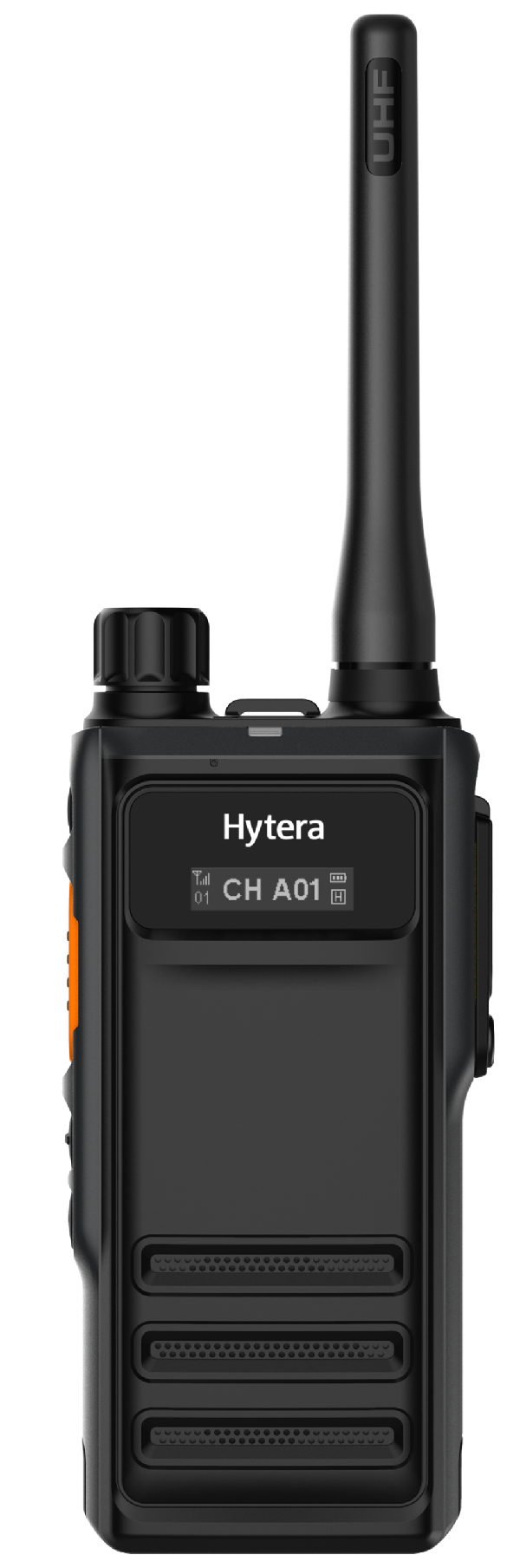
Hytera HP602 V1 Two-Way Radio, 4W, 1024C, Analog/DMR, IP67, MD, 1-Line Display, VHF(136-174MHz) - H08
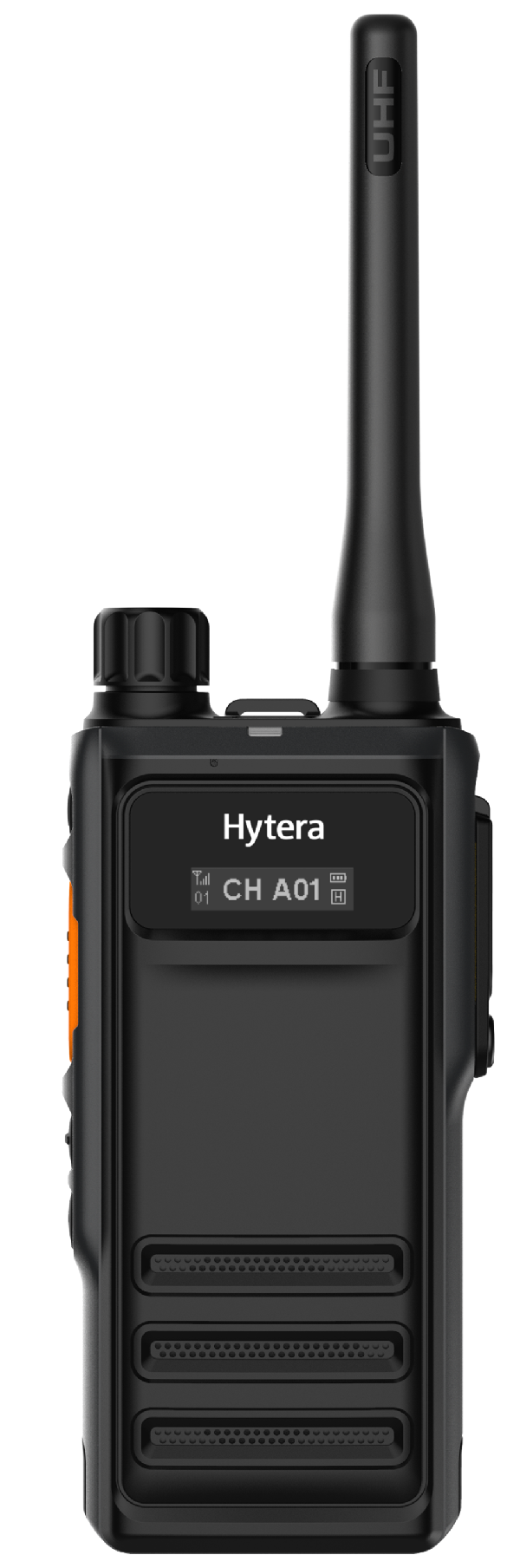
Hytera HP602 Two-Way Radio, 4W, 1024C, Analog/DMR, IP67, MD, 1-Line Display, UHF(400-527MHz) - H08
Wavelength and Antenna Physics
The relationship between wavelength and antenna design is direct and practical. A radio antenna works most efficiently when its physical length is a specific fraction of the transmitted wavelength — typically a quarter or half wave. This means:
A VHF radio at 150 MHz needs a quarter-wave antenna of about 50 cm. Engineers shorten this with loading coils or helical winding, but efficiency is sacrificed. A UHF radio at 450 MHz needs a quarter-wave antenna of only about 16.7 cm — short enough to be practical without compromise. This is a real-world engineering advantage of UHF and partly explains why UHF radios tend to feel sleeker and are easier to carry and deploy in tight spaces.
FCC License
This article contains FAQs - UHF vs VHF
Quick Decision Reminder: Outdoors / open terrain = VHF|Indoors / urban / multi-floor = UHF|Both = Dual-Band
